

Lost Connections: Rethinking the Causes and Cures of Depression

Dr Avni S. Tiwari
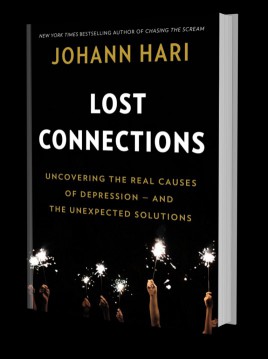
Lost Connections: Uncovering the Real Causes of Depression and the Unexpected Solutions (Bloomsbury) by Johann Hari is an engrossing and thought-provoking read on depression and mental health. It begins with a personal story of being diagnosed with depression and prescribed ‘pills’. The author smartly avoids what he calls ‘pain porn’ and then slips into a familiar trope about an exotic Asian town doctor offering life-changing insight. He uses this experience to motivate his search for the truth behind depression, a condition that affects millions worldwide every year. Most of us have either experienced it or know someone who has, making this exploration deeply relevant.
Understanding Depression: Brain Chemistry or Life Circumstances?
The book remains engaging despite touching upon technical concepts like neurotransmitters and the placebo effect. Johann Hari explains these mental health concepts in a simple and lucid manner. Research studies from peer-reviewed journals—often considered dense reading—are summarised clearly, though some conclusions may seem slightly contrived.
The author briefly discusses endogenous depression (linked to biology) versus reactive depression (triggered by external factors). He also makes an important observation: anxiety symptoms often co-occur with depressive symptoms, highlighting the complexity of mental health disorders.
A central question he raises—frequently debated in psychiatry—is: what causes depression? Is it the brain going wrong, or life going wrong?
After rejecting the idea that antidepressants are the “be-all and end-all,” he introduces what he calls the real causes—disconnections—and this is where the book becomes particularly compelling.
Hari identifies nine causes of depression, seven of which he explores in detail. Many are self-evident yet powerfully illustrated. The first is lack of meaningful work; the second, disconnection from other people leading to loneliness—both key social causes of depression. The third examines how conflicting intrinsic and extrinsic values can mislead us, with advertising and consumer culture damaging self-esteem. The fourth—adverse childhood experiences—is widely acknowledged and difficult to dispute.
Causes five, six, and seven focus on lack of status and respect, disconnection from nature, and the inability to envision a hopeful or secure future. These are crucial not only for individuals but for society. Factors like immigration and urbanisation are well-known contributors to rising depression rates. The author even uses the example of bonobo apes to illustrate the harmful effects of losing one’s natural habitat.
He concludes the causes with genetics and brain changes, briefly discussing the serotonin transporter (5HTT), though he downplays its overall significance in biological depression theories.
Reconnecting the Dots: Practical Solutions to Depression
The second half of the book explores solutions to depression, focusing on reconnecting with what we’ve lost. Early chapters suggest alternative approaches, including social activism and the healing power of community—reinforcing the idea that “you are not alone.”
Seven chapters are dedicated to reconnection strategies: reconnecting with people, finding meaningful work, shifting from materialistic to meaningful values, healing childhood trauma, and rebuilding hope for the future. These align closely with the earlier causes discussed.
One of the book’s highlights is the chapter on Social Prescribing, a growing concept in mental health care. It emphasises reconnecting with nature, engaging in meaningful activity, and allowing time for healing. The idea that a doctor might prescribe gardening or community work as therapy is both novel and compelling. These examples reinforce the author’s core message: revisit what you’ve lost, rebuild connections, and restore balance.
Another important chapter explores sympathetic joy—the ability to feel happiness for others. Hari argues that excessive individualism contributes to depression, while shared joy and connection can act as powerful antidotes. He also discusses meditation, psychedelics, and the importance of experiencing a deeper connection with oneself and the world.
In the concluding sections, the author offers some caution. He acknowledges that milieu therapy (changing environment alone) may not have lasting effects. He also concedes that antidepressants are not entirely ineffective and should not be dismissed outright.
A Balanced View: Strengths, Gaps and Final Takeaways
However, two concerns stand out. First is the widely accepted bio-psycho-social model of depression, endorsed by the World Health Organization. While Hari focuses heavily on social factors, psychological and biological aspects are not explored in equal depth. Factors like personality differences and varied responses to similar life situations—often highlighted in twin studies—seem underrepresented.
Second, while biology and psychology may be universal, social and cultural contexts differ widely. Although framing depression as purely biochemical may create stigma, it can also encourage individuals to seek professional help—whether through medication, therapy, or social prescribing. Dismissing the experiences of millions who benefit from antidepressants, especially in developing countries, may not be entirely balanced.
Ultimately, Johann Hari presents a self-help and mental health guide grounded in observation, anecdotal evidence, and selected research. Rather than offering direct instructions, he provides insights and perspectives, leaving readers to adapt these ideas to their own lives—a task that can feel both empowering and overwhelming.
Dr Avni S. Tiwari is a psychiatrist based in Noida

1 Comment
[…] help for anxiety or depression is an important part of survivorship care and should never be viewed as a sign of […]