

Ayurveda Takes Root: How Ashwagandha Could Support the Restoration of Delhi’s Aravallis


Team L&M
The restoration of the Aravallis is not only about planting trees. It is also about rebuilding biodiversity, bringing degraded landscapes back to life and finding sustainable ways to reconnect people with the natural ecosystems around them. In Delhi’s Southern Ridge, a new initiative is exploring that connection through a plant deeply rooted in India’s traditional system of medicine—Ashwagandha.
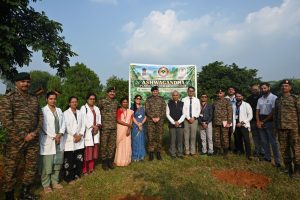
The All India Institute of Ayurveda (AIIA), New Delhi, and 132 Infantry Battalion (Territorial Army) ECO RAJPUT have joined hands to establish an Ashwagandha plantation and research initiative at the Terriers Herbal Garden in Bhatti Mines, South Delhi. The collaboration brings together AIIA’s work in Ayurveda, medicinal plants and scientific research with the Ecological Battalion’s experience in plantation, biodiversity conservation and restoration of degraded landscapes.
At the heart of the initiative is the planned plantation and scientific monitoring of 10,000 Ashwagandha (Withania somnifera (L.) Dunal) saplings.
More than a plantation exercise
What makes the initiative noteworthy is its focus on what happens after the saplings go into the ground.
The participating organisations plan to regularly observe, monitor and document the Ashwagandha plants. Such documentation could provide useful information about how the medicinal plant grows and adapts to the climatic and environmental conditions of the Aravali Hills.
This approach also creates an interesting bridge between traditional knowledge and contemporary research. Ayurveda has recognised Ashwagandha as an important medicinal plant for centuries, while scientific monitoring can help generate a clearer understanding of how such plants respond to particular environmental conditions.
For an ecologically sensitive landscape such as the Aravallis, that intersection between traditional plant knowledge and scientific observation has wider relevance. Medicinal plants can become part of conversations around biodiversity conservation India rather than remaining confined to their therapeutic applications.
Prof. (Vaidya) Pradeep Kumar Prajapati, Director, AIIA, describes the initiative as a way of bringing Ayurvedic knowledge of medicinal plants together with scientific research and ecological restoration.
“Ashwagandha is an important medicinal plant of Ayurveda, and its systematic cultivation, conservation and scientific documentation can contribute to both knowledge generation and biodiversity conservation,” he said.
He also highlighted the broader objective of strengthening Ayurveda’s connection with nature and sustainability.
Giving a medicinal-plant garden a larger purpose
The Terriers Herbal Garden already provides a foundation for this work. The garden houses around 200 species of medicinal and Ayurvedic significance, including Parijata (Harshringar), Amla (Indian Gooseberry) and Ghritkumari (Aloe Vera).
AIIA has been entrusted with providing technical support for the garden’s maintenance and scientific management. The Ashwagandha initiative therefore builds on an existing collection rather than creating an isolated plantation project.
The garden can also serve a larger educational and research purpose. By bringing together different medicinal species in one landscape, it offers an opportunity to study, conserve and document plants associated with India’s traditional health knowledge while demonstrating the role that such gardens can play in biodiversity conservation India.
Why Bhatti Mines matters
The location adds another important dimension to the initiative.
Bhatti Mines lies within Delhi’s Southern Ridge and the wider Aravalli range restoration landscape, an area that has experienced significant ecological pressure, including degradation associated with mining. The 132 Infantry Battalion (Territorial Army) ECO RAJPUT has been involved in efforts to restore and green degraded areas in the region.
Planting Ashwagandha here consequently becomes part of a broader restoration story. The objective is not simply to increase the number of plants in the area, but to explore how carefully selected medicinal species, scientific observation and conservation efforts can work together to support an evolving ecosystem.
The initiative also reflects a wider shift in environmental restoration India, where restoration involves more than putting plants into the soil. It requires attention to biodiversity, the suitability of species, long-term survival, ecological conditions and continued monitoring.
Connecting with the larger Aravalli restoration effort
The ecological importance of the Aravallis has made their protection and regeneration the subject of several conservation initiatives. The Aravalli Green Wall Project is one such effort aimed at increasing green cover and restoring degraded areas across the broader Aravalli landscape.
Against this wider backdrop, initiatives such as the Ashwagandha plantation offer a more localised approach to Aravalli range restoration. Their value will depend on how effectively planting, scientific monitoring and long-term ecological management come together.
The history of environmental degradation in parts of the landscape also makes discussions around the Aravalli hills mining ban relevant to the larger conservation picture. Mining-related degradation has affected sections of the range, while legal and conservation measures have sought to protect environmentally sensitive areas.
Where Ayurveda meets environmental stewardship
Ashwagandha occupies an interesting space in this conversation because of its longstanding place in Ayurveda and its growing contemporary interest. The National Medicinal Plants Board, Ministry of Ayush, has also undertaken the “Ashwagandha – A Health Promoter” campaign to raise awareness about the plant.
The new plantation initiative adds an ecological dimension to that conversation. Instead of looking at Ashwagandha only through the lens of its traditional uses, it brings questions of cultivation, conservation, adaptation and scientific documentation into focus.
For AIIA, the collaboration extends its role beyond clinical practice and medicinal research. For the Ecological Battalion, it adds medicinal-plant expertise to ongoing environmental restoration efforts.
That combination could prove particularly relevant in urban landscapes, where ecological restoration has to coexist with the pressures of a rapidly growing city. It also places the project within the broader context of environmental restoration India, where institutions are increasingly looking at ways to combine scientific knowledge with practical conservation.
Building a living laboratory
The collaboration, led by Prof. (Vaidya) Pradeep Kumar Prajapati, Director, AIIA, and Col Mohan Singh, Commanding Officer, 132 Infantry Battalion (Territorial Army) ECO RAJPUT, began with the Ashwagandha Plantation & Research Initiative on 24 September 2026.
The planning and implementation were coordinated by Maj Jai Singh Shekhawat of 132 Infantry Battalion (Territorial Army) ECO RAJPUT and Maj (Dr) Ashish Kumar of AIIA. Dr. Meena Deogade, Head, Department of Dravyaguna, along with faculty members Dr. Shivani Ghildiyal, Associate Professor, Dr. Bidhan Mahajon, Assistant Professor, and PhD research scholars from the department, are also associated with the initiative.
But the significance of the project will ultimately be measured not by the launch itself, but by what the landscape looks like over time.
If the 10,000 saplings establish successfully, the scientific observations generated along the way could offer useful insights into cultivating medicinal plants in the local environment. The experience could also inform future efforts to combine medicinal-plant conservation with ecological restoration.
That makes the project more than a plantation drive. It has the potential to function as a living laboratory—one where Ayurveda, plant science and environmental restoration meet on the ground.
Planting a different idea of conservation
The Aravali Hills have long been part of Delhi’s ecological identity, but restoring a degraded landscape is necessarily a long-term process. It requires continuity, scientific understanding and an appreciation of the many forms of life that make an ecosystem function.
The Ashwagandha initiative brings another perspective to that effort: India’s traditional knowledge of medicinal plants can become part of contemporary conservation conversations.
Its message—“Roots in Ayurveda – Conserve Biodiversity – Restore Ecosystems”—captures that connection. The real test, however, will come with time, as the saplings grow, researchers document their progress and the landscape continues its slow process of regeneration.
The initiative also sits within the wider conversation around an afforestation drive India, where planting programmes increasingly seek to combine tree and plant cover with ecological restoration, biodiversity and long-term landscape management. The Ashwagandha plantation offers a medicinal-plant dimension to that broader effort.
The debate around the Aravalli hills mining ban further underlines the importance of protecting and restoring areas that have experienced environmental pressure. While plantation alone cannot reverse decades of degradation, carefully planned and monitored interventions can become part of a larger restoration strategy.
In that sense, the most interesting part of this initiative may not be the day the Ashwagandha was planted. It may be what happens in the years that follow—and whether those roots can contribute to a healthier, more diverse Aravali Hills landscape.
The initiative ultimately connects Ayurveda with an afforestation drive India, scientific research with conservation, and medicinal-plant knowledge with the long-term challenge of restoring one of Delhi’s most important natural landscapes.
