

Crafted for Conversations: Why Thoughtful Design Changes How We Show Up
- HOME DECOR
 Life&More
- 0
- 9 minutes read


Suumit Arora
There is something that happens in a well-considered space that no one in the room can quite account for. The conversation goes somewhere real, someone says something they had not planned to say.
The exchange, then feels less like an obligation and more like something that needed to happen. Afterwards, people rarely credit the room. They credit the person, the mood, the timing. The room did its job so quietly that nobody noticed it working.
This is what thoughtful design actually does when it is done well. It removes itself from conscious awareness and operates underneath, shaping how people feel without asking them to notice.
A space that has been genuinely considered tells the people inside it, before anyone opens their mouth, that what happens here has been taken seriously. That message changes the quality of what follows.
Visual Noise Has a Cost That Never Appears on Any Bill
Most people living in overstimulating spaces have simply stopped registering what they contain. The shelves covered in objects kept out of habit, the walls with too many things fighting for the same attention, the room that has accumulated rather than been composed. The adjustment happens gradually and the cost is paid in attention, in the low-grade mental taxation of being inside a space that never quite resolves.
What most people do not realise is that this taxation does not pause when a conversation starts. The brain continues reading the room even while the mouth is speaking, running its background audit of surfaces and visual weight and unresolved questions about what the space is supposed to be.
The conversation happens on top of all of this rather than in a place cleared for it. The people in the room are present, but not fully, because the room is still demanding something from them.
A space designed with genuine editorial restraint, where the decisions about what to take away have been made as seriously as the decisions about what to keep, changes this dynamic entirely. The eye settles. The mind follows. The people inside arrive at each other with attention that has not already been spent on the walls.
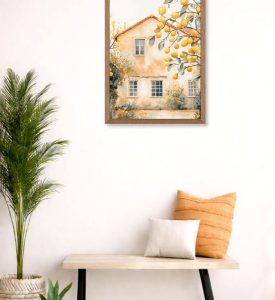
Decorating and Designing Are Not the Same Undertaking
The distinction is worth sitting with because most homes are decorated and very few are designed, and the difference in how they feel to be inside is not subtle. Decorating is additive. Something is empty, something gets placed in it, the emptiness is addressed. Designing asks a different question entirely, not what fills this space but what this space is for and what it needs to do that well.
Walk into a home where art arrived last, chosen after every other decision had already been made, and the sequence shows. Everything is present and the room still feels unresolved because nothing is leading it. The eye moves across the surfaces looking for somewhere to land and keeps moving. People in that room are comfortable in the way that familiar discomfort becomes comfortable, they have simply learned to live with the friction.
One piece chosen with genuine intention, chosen first and chosen for what it gives the room rather than what it fills, changes the whole equation. The space acquires a centre. Everything else can organise around it rather than compete with it. The room stops asking to be looked at and starts being somewhere worth being inside.
What a Considered Space Communicates Before Anyone Speaks
Spaces communicate and they do not wait to be asked. A room that feels genuinely thought about tells the people who enter it that their presence there has been prepared for, that the quality of what happens in this space matters to whoever is responsible for it. This message is not delivered consciously but it is received, and it shapes how people carry themselves in the room and how open they are when the conversation finally starts.
This is particularly relevant in the spaces where real exchange is supposed to happen. The home, the sitting room, the study, the places where people are meant to stop performing and actually be present with each other. Design that serves those spaces does not show off. It gets out of the way.
A single piece of art chosen with conviction does more for that kind of room than a dozen objects assembled over years of uncertain purchasing, because conviction is visible even when the thinking behind it is not. People feel it without being able to explain what they are feeling.
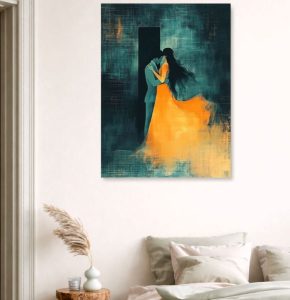
The Generation Buying Art Differently
The collectors shaping how homes are assembled today are approaching the decision with a seriousness that previous generations reserved for larger investments. Research on serious buyers shows that younger collectors are investing more of their wealth in art than any other age group. They are also purchasing directly from artists. For them, choosing what goes on a wall is not just decoration. It is a genuine expression of how they want to live, rather than a finishing touch added after all the major decisions are made.
What drives this is not primarily investment logic, though that conversation is happening too. It is something more immediate.
A room does not need to be rebuilt to feel fundamentally different. What most overstimulated, visually restless spaces are missing is not another object but a single clear decision. That one piece holds enough presence to give the eye somewhere to rest. Everything else in the room settles naturally around it.
Most people keep adding more things to a room. Then they wonder why the space still feels incomplete. In reality, the solution is often the opposite of adding more. The best rooms for real conversations are not always the most expensive or perfectly curated. They are spaces where someone made a thoughtful choice and trusted it to be enough.
That kind of clarity changes the entire atmosphere of a room. It creates a space where people can truly relax and connect. The room quietly does its work before anyone even arrives. As a result, conversations flow more naturally because nothing in the environment is competing for attention.
Suumit Arora is the Founder & CEO of Artiure
