

Visions of Freedom: How Indian Artists Captured the Spirit of Independence
- VISUAL ARTS
 Life&More
- 0
- 4 minutes read


An untitled art work by KK Hebbar
Sunny Chandiramani
India’s journey to independence was not shaped by political movements alone. It was also reflected in the cultural expressions of the time, with artists using their work to articulate ideas of identity, resilience and freedom. From the Bengal School’s revival of indigenous artistic traditions to the modernist experiments that followed Independence, Indian art became an important part of the country’s evolving visual identity.
Bharat Mata – An Icon of Culturaal Nationalism
Among the most enduring examples is Abanindranath Tagore’s Bharat Mata, painted in 1905 during the Swadeshi movement. Depicting Bharat Mata as a serene, saffron-clad woman holding a manuscript, rice, cloth and a garland, the work moved away from conventional representations of the nation. Instead, Tagore presented India as a nurturing and spiritual mother, embodying the ideals of self-reliance and cultural renewal that were central to the nationalist movement.
The Bengal School, of which Tagore was a leading figure, sought to establish an artistic language rooted in Indian traditions at a time when Western academic realism dominated colonial art institutions. Nandalal Bose, another important figure of the movement, similarly drew inspiration from Indian folk traditions, mythology and everyday life. His nationalist works demonstrated how art could become a powerful vehicle for cultural assertion.
Nandlal Bose and the Constitution
Bose’s contribution to the visual culture of independent India extended beyond paintings. In 1949, he and his team at Kala Bhavana decorated the original handwritten Constitution of India. The illustrations drew from India’s rich civilisational history, incorporating episodes from the Ramayana and Mahabharata, Buddhist traditions, Mughal and Rajput art, as well as scenes from everyday Indian life. Together, these images created a visual narrative of India that was rooted in its diverse cultural heritage.
With Independence in 1947, the role of Indian artists began to evolve. The country was no longer simply imagining freedom; it was grappling with what it meant to build a new nation. The decades that followed witnessed the rise of Indian Modernism, with artists looking beyond established conventions to find new ways of expressing a rapidly changing society.
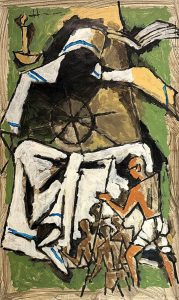
Mother Teresa and Gandhi, an artwork by MF Husain
MF Husain and a Plural India
M F Husain became one of the most recognisable voices of this generation. His dynamic figures, bold forms and references to mythology, cinema, folklore and everyday life reflected the plurality of Indian culture. Rather than presenting a singular idea of India, Husain’s work often embraced its contradictions and diversity, capturing a country constantly negotiating between tradition and modernity.
Similarly, artists such as S H Raza, F N Souza and Tyeb Mehta explored questions of identity, existence, displacement and belonging through radically individual visual languages. They showed that India’s independence could not fit into a single aesthetic or narrative.
Art as a Record of Changing Nation
Over time, Indian art became a record of the nation’s transformation — from the cultural assertion of the freedom movement to the uncertainties and possibilities of a newly independent society. The artists who worked across these periods did more than document history; they helped shape how India imagined itself.
Today, as the country reflects on its journey since 1947, their works continue to offer another way of understanding independence — not merely as a political milestone, but as an evolving idea of identity, expression and belonging.
Sunny Chandiramani is Director – Client Relations at AstaGuru Auction House
