

Jehangir Sabavala: The Quiet Modernist Who Created a World of His Own
- VISUAL ARTS
 Life&More
- 0
- 5 minutes read


Senha Gautam
Some artists command attention through bold gestures; others draw the viewer in through silence. Jehangir Sabavala belonged to the latter. His paintings, characterised by geometric forms, muted palettes and contemplative landscapes, created a unique visual world that remained deeply personal throughout his career.
Born on 23rd August 1922, in Bombay, Sabavala emerged as one of the most individualistic voices of Modern Indian Art. His artistic journey took him from the Sir J J School of Art in Bombay to London and Paris, where he encountered European modernism and the structural principles of Cubism. Yet, rather than simply adopting these influences, Sabavala gradually transformed them into a visual language which was unmistakably his own.
At a time when Indian modernism was often associated with the radical experiments of the Progressive Artists’ Group, Sabavala followed a more independent route. His career is a reminder that the story of Modern Indian art was never defined by a single movement or aesthetic.
Landscapes of Contemplation
Sabavala’s most enduring subject was landscape, but his paintings were never straightforward representations of nature. Mountains, skies, water and earth were reorganised into planes and geometric structures, creating spaces that seemed to exist somewhere between reality and memory.
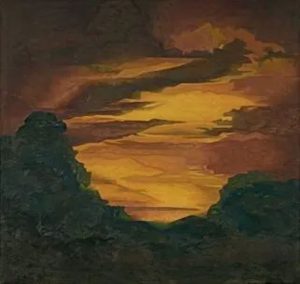
The Sky Like a Furnace Burning, painted in 1968, reflects his fascination with the dramatic skies and sunsets of Mahabaleshwar. Yet the work goes beyond depicting a particular landscape; colour, light and form combine to create an atmosphere of quiet intensity.
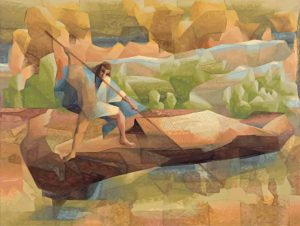
Another similar sensibility can be found in The Boatman, an oil on canvas from 1980. A solitary figure occupies a vast landscape, appearing almost insignificant against the expanse around him. This relationship between the individual and the larger natural world became an important thread throughout Sabavala’s practice.
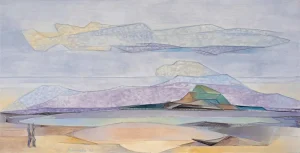
His mature works further reveal this distinctive visual vocabulary. His 1998 Untitled, a large-scale composition in soft shades of lavender, blue and green, presents a dreamlike landscape of layered geometric forms, with two distant figures reinforcing its sense of scale and solitude.
The Poetry of Solitude
Sabavala’s figures are rarely conventional protagonists. They appear as travellers, boatmen or distant forms, often absorbed in their surroundings. Their anonymity allows them to become universal rather than specific, suggesting ideas of journey, reflection and solitude.
This quality is particularly evident in his 1966 work, In the Ambush of a Calm. Even its evocative title hints at the subtle tension beneath Sabavala’s seemingly serene compositions. His landscapes may appear still, but they are never entirely static. There is always a suggestion of movement, transition, or something just beyond the visible.
His restrained palette enhances this sense of introspection. Rather than relying on dramatic contrasts, Sabavala worked through carefully modulated tones, allowing atmosphere and geometry to carry the emotional weight of the composition.
A Modernist in His Own World
The importance of Sabavala’s art lies in his resistance to easy categorisation. His oeuvre reflects the influence of European modernism without being derivative. He chose to engage with nature without creating conventional landscape painting, while incorporating abstraction without completely abandoning recognisable forms.
Today, as the understanding of Modern Indian art expands beyond its most familiar names and movements, Sabavala’s practice invites renewed attention. His paintings demonstrate how modernity could be expressed not only through rupture and rebellion, but also through patience, discipline and introspection.
Perhaps that is the enduring appeal of Jehangir Sabavala. His paintings do not demand immediate answers. They invite the viewer to slow down, look closely, and enter a world shaped by silence, geometry, light, and memory. In an increasingly hurried visual culture, that quietness might be his most distinctive legacy.
Sneha Gautam is Director – Client Relations at AstaGuru Auction House
