Sreedevi Rajan: A Life Dedicated to the Grace, Glory and Legacy of Mohiniyattam
- SANDIP SOPARRKAR
 Life&More
- 0
- 8 minutes read


Remembering a distinguished classical dancer, choreographer, guru and custodian of India’s cultural heritage.
The world of Indian classical dance has lost a remarkable artist with the passing of Guru Sreedevi Rajan, the celebrated Mohiniyattam exponent who devoted her life to the preservation, development and propagation of one of Kerala’s most graceful classical dance forms. She passed away recently, at the age of 84. Her departure marks the end of an extraordinary chapter in the history of Indian classical dance, but the artistic legacy she leaves behind will continue to inspire generations.
For those who understand dance not merely as movement but as an expression of the soul, Sreedevi Rajan represented the very essence of sadhana — a lifelong commitment to the pursuit of artistic excellence.
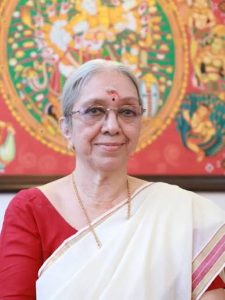
Born into a Legacy, Destined to Create Her Own
Sreedevi Rajan was born into one of Kerala’s most distinguished artistic families. She was the daughter of the legendary Kathakali maestro Kalamandalam Krishnan Nair and Guru Kalamandalam Kalyanikutty Amma, revered as the Mother of Mohiniyattam. Growing up in such an environment meant that music, rhythm, expression and storytelling were not simply artistic disciplines; they were part of everyday life.
Yet, inheriting a great tradition is one thing; making a meaningful contribution to it is another. Sreedevi did both.
Her introduction to classical dance began in early childhood. She trained in Mohiniyattam under her mother, Kathakali under her father, Bharatanatyam under A. R. R. Bhaskar, and Carnatic music under Professor Kalyanasundaram. Her arangetram in Bharatanatyam and Mohiniyattam took place when she was just five years old — an extraordinary beginning to a journey that would span decades.
Such comprehensive training gave her an understanding of classical dance that extended beyond technique. She developed an appreciation for the relationship between movement, music, literature, dramatic expression and the emotional worlds of the characters portrayed on stage.
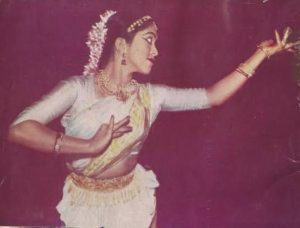
The Mohiniyattam Dancer Who Gave Literature a Body and Emotion a Language
One of Sreedevi Rajan’s most significant contributions was her ability to expand the expressive possibilities of Mohiniyattam. Rather than limiting herself to an established repertoire, she explored ways of bringing Malayalam poetry and literary works into the language of dance. Her work demonstrated that classical forms can remain rooted in tradition while continuing to engage with new ideas and artistic interpretations.
This was the work of an artist who understood that classical dance is not a museum piece. It is a living tradition that grows through study, imagination and thoughtful innovation.
Her scholarly contribution, Mudrakhyam: A Visual Dictionary of Mohiniyattam Hand Gestures, offered a valuable resource for understanding and documenting the hand gestures used in the form. The book reflected her commitment to preserving the knowledge that lies behind every movement, gesture and expression. Such documentation is especially important in classical arts, where knowledge is often transmitted from guru to disciple through years of observation and practice.
As a choreographer and composer, she also explored the relationship between literature and performance, demonstrating that the dancer can be both an interpreter of inherited knowledge and a creator of new artistic possibilities.
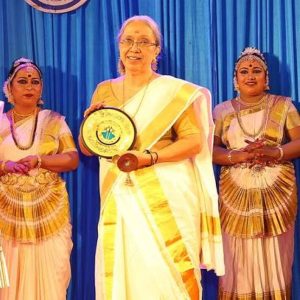
Guru Sreedevi Rajan: The Teacher Who Shaped Generations
An artist’s greatness is measured not only by the applause received on stage but also by the lives transformed through teaching.
Sreedevi Rajan served as a teacher at Cochin Refineries School and later directed Nrithyakshetra, her dance institution in Kochi. Through teaching, choreography and mentorship, she helped nurture an environment in which classical dance could be studied, practised and passed on to future generations.
The relationship between a guru and a shishya has always held a special place in Indian artistic traditions. It is a relationship built on trust, discipline, patience and the transmission of knowledge that cannot be fully captured in textbooks.
A guru teaches the correct movement, but also the reason behind it. She explains rhythm, but also teaches a student to listen. A guru corrects a gesture, but ultimately guides the student towards discovering an individual artistic voice.
Sreedevi Rajan’s lifelong involvement with dance embodied this tradition of learning and sharing. Her influence continues through her students, her institution and the artistic work of her daughters.
Sreedevi Rajan’s Awards and Recognition
Her dedication received recognition from respected cultural institutions. She was honoured with the Kerala Sangeetha Nataka Akademi’s Kalasree Award and other distinctions during her career. In 2024, she received the Central Sangeet Natak Akademi Award for Mohiniattam. This award is one of India’s significant national recognitions for excellence in the performing arts.
These honours celebrated more than individual achievement. They acknowledged a lifetime spent strengthening an artistic tradition and ensuring that its techniques. Awards are important because they bring visibility to an artist’s contribution. Yet, the deepest measure of an artist’s success is often found elsewhere: in the student who carries a lesson forward, in the performance that moves an audience, and in the tradition that survives because someone cared enough to preserve it.
By that measure, Sreedevi Rajan’s contribution reaches far beyond the honours attached to her name.
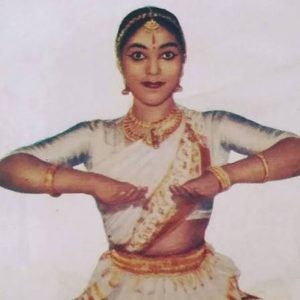
Sreedevi Rajan’s Legacy: A Life That Will Continue to Dance
As a choreographer, dancer and storyteller, I have always believed that classical dance is one of India’s greatest cultural treasures. It brings together movement, music, mythology, poetry, philosophy and human emotion. Every classical form carries centuries of experience, and every dedicated guru becomes a bridge between the past and the future.
Sreedevi Rajan’s life reminds us of the importance of those bridges.
Her story also reminds us that artistic greatness does not require a constant search for novelty. Sometimes, the most meaningful contribution is to understand a tradition deeply, honour its foundations. And, also find ways to keep it alive in a changing world.
Mohiniyattam, with its flowing movements, delicate expressions and lyrical quality, possesses a distinctive beauty. Preserving that beauty requires both technical mastery and a sensitive understanding of its spirit. Through her performance, teaching, choreography and scholarship, Sreedevi Rajan devoted herself to that responsibility.
Today, as dancers and admirers remember her, there is grief at the loss of a respected guru. But, there is also gratitude for the knowledge she shared and the artistic path she helped sustain.
A dancer’s body eventually grows still. The stage lights fade, the music comes to an end, and the curtain falls. But the art does not disappear. It remains in the movements remembered by students, in the gestures preserved in books. IT is also preserved in the poetry interpreted through dance, and inspiration passed from one generation to another.
Guru Sreedevi Rajan may have taken her final bow, but the rhythm of her contribution will continue. May her soul rest in peace. May her legacy live on through every dancer who honours Mohiniyattam, every student who learns with dedication.
Sandip Soparrkar holds a doctorate in world mythology folklore from Pacific University USA, an honorary doctorate in performing arts from the National American University, He is a World Book Record holder, a well-known Ballroom dancer and a Bollywood choreographer who has been honored with three National Excellence awards, one National Achievement Award and Dada Saheb Phalke award by the Government of India. He can be contacted on sandipsoparrkar06@gmail.com