

Let an Illustration Keep Its Own Voice
- VISUAL ARTS
 Life&More
- 0
- 7 minutes read

An illustration invites a particular kind of attention. A viewer can pause over a line, compare two shapes or return to a small detail without being carried forward by a timeline. Adding motion creates another experience. It can guide the eye and suggest a sequence, but it can also change the balance that made the still image meaningful.
For an artist sharing original work, the question is not simply whether the picture can move. The more useful question is what a moving interpretation adds, and whether the original remains available on its own terms. A thoughtful presentation can offer both without treating animation as a replacement for the drawing.
Begin with the drawing’s point of attention
Consider an invented illustration of three paper boats arranged beside a blue circle. It is an original composition, not a photograph of an event or a reproduction of another artist’s work. Perhaps its central idea is the contrast between fragile-looking shapes and a strong field of colour.
Before introducing motion, write a short description of what matters in the still. The relationship between the boats may be important. So might the distance from the blue circle or the texture of the lines. These observations become a reference for evaluating any later interpretation.
This description need not explain the artwork completely. It can simply identify the features that the artist wants to preserve. Leaving room for the viewer’s response is different from leaving the production process unclear.
Give the original a complete presentation
Show the illustration as a still image with a title and an appropriate caption. Identify it as original artwork and explain any context needed to understand the presentation. Do not make someone watch a clip before they can inspect the composition.
Choose a crop that respects the work. A narrow preview may remove the space around the boats, changing the relationship between the objects. If the full drawing cannot fit comfortably in one layout, provide a way to view it separately rather than pretending that the cropped version is the complete composition.
Keep essential written information outside the image too. A readable caption can identify the source and medium without requiring the viewer to decipher small lettering embedded in the artwork.
Describe the purpose of movement
Motion can do several different jobs. It might reveal the drawing in stages, direct attention between elements or create an independent variation. Decide which of those jobs belongs to the project before choosing how to make the clip.
For the paper-boat illustration, a sequence could introduce the blue circle and then reveal the boats. That is a presentation of the composition. Making the boats sail away creates a new story. Neither choice is automatically wrong, but they represent different relationships with the original.
Write that relationship into the brief. “A staged reveal of the original illustration” sets a different expectation from “A fictional motion variation inspired by the illustration.” Clear language helps everyone reviewing the work respond to the same idea.
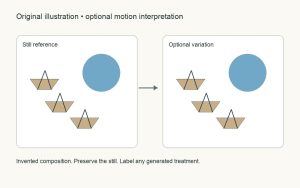
The still artwork remains the reference. Optional motion can present its composition or explore a separate interpretation.
Use controlled animation when the order matters
If the intended sequence is precise, authored animation gives the creator direct control. Each boat can appear at a chosen moment while its shape and position remain unchanged. A highlight can move between details without redrawing them.
Keep the movement proportionate to the idea. A small reveal may be sufficient. Extra transitions can compete with the line work or suggest a mood that the original never expressed. Reviewing a simple version first makes it easier to judge what motion actually contributes.
Provide pauses long enough for captions and important details to be understood. If the piece needs a lengthy explanation to justify every transition, the still image may already be the clearer presentation.
Keep generated interpretations visibly separate
An artist can also explore an owned illustration through generated motion. For example, an image-to-video workflow can provide a way to develop a moving interpretation of an original drawing. The result should be reviewed as a new treatment, not assumed to preserve every decision in the source.
Compare it with the still reference. Do the boats retain their shapes? Does the circle remain a circle? Have new objects or textures appeared? A change may be interesting as a variation while still being unsuitable as a presentation of the original composition.
Use a caption such as “Generated motion interpretation of original artwork.” If the scene could be mistaken for something recorded, add that it is not footage of an actual event. The description should travel with the clip rather than staying in a private production note.
Keep a short version note with the final files. It can identify the source drawing, the selected treatment and any intentional changes. This is useful when a gallery page, newsletter or social caption is prepared later by someone else. The note helps preserve context without requiring that person to reconstruct the decisions from several similar clips or an unfinished folder.
Let viewers choose their pace
Offer motion as an optional experience alongside the still. A viewer may want to inspect the drawing slowly, compare details or avoid movement altogether. Keeping the original accessible respects those different ways of looking.
Describe the sequence in ordinary text when it carries meaning. If audio provides information, make that information available in writing. A silent viewer should not lose the central idea, and someone who does not play the clip should still understand the relationship between the original and its treatment.
Before sharing, review the title, caption and surrounding text together. They should describe the work that is actually being presented. A moving variation can have its own value while the still illustration continues to speak through its own composition, without being reduced to a starting frame.
Explore a character variant as a separate artistic treatment
If the creative project includes a character performance, Magic Hour AI character replacement uses a source video and a reference image to replace its subject. Use your own or permitted materials, keep the original performance available for comparison, and review the character’s contours and movement. Identify the result as a synthetic artistic variant rather than a record of the original drawing process.
If the concept includes a fictional illustrated presenter, Magic Hour lip sync AI is an option for matching the fictional character’s mouth movement to an authorised audio track. Identify generated speech and motion clearly; do not use the sequence to imply a real person said something they did not say.
For a separate creative experiment, describe a fictional illustrated presenter in a written prompt and explore it with Magic Hour AI video generator. Keep the result labelled as generated imagery, compare it with the storyboard and retain a still alternative; the generated scene is not evidence of a real event or a tested outcome.
About the contributor: Magic Hour creates tools for making and editing visual content.
