

San Francisco Carnival Queen Adela Chu: Dance, Legacy & Creation of Carnaval SF
- SANDIP SOPARRKAR
 Life&More
- 0
- 9 minutes read

.For a Latin American dance lover, the high point in life is to dance at a carnival. There are two most famous carnivals in the world that we all know of, the Rio de Janeiro and the San Francisco carnivals, these are the two most talked about carnivals that people travel from far and wide to either participate or to witness.
My recent trip to United States of America was a hectic one and to relax and chill for a week in between my assignment, I took a trip to Hawaii, all thanks to my dear friend, the world-renowned Dr Daniel Susott who owns one of the most beautiful tree houses in the world in Oahu Island, Hawaii.
I could not have asked for a better holiday than this. A tree house was so peaceful and clam, filled with rare and exotic plants and trees, with fruits and vegetables growing right next to the private stream. It was like being up in the Garden of Eden with luxuries attached. One day, Dr Susott pushed me to get out of the hammock and dragged me to an evening of music and dance where he was singing at a Latino bar.
I could not believe myself when he introduced me to his dear friend, the legendary Adela Chu. Those of you who know about the San Francisco Carnival would surely know that the dynamic Adela Chu is the grand queen of the world-famous San Francisco Carnival. She is the one who began the carnival back in 1979.
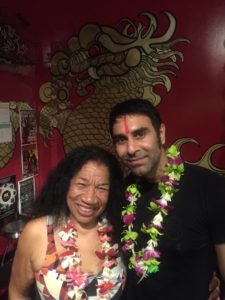
Meeting Adela Chu was the best part about my trip. She has such a magnetic personality that each person at the bar could not take their eyes off her when she entered. With a broad smile on her face, she greeted one and all and when she met me, she hugged me tight and said, “Man from Gandhi’s land”.
For me, meeting Adela Chu was like a dream come true because I had only read about her in the books of the carnivals, seen her pictures flashed all over the news for being the mother of the San Francisco Carnival.
Apart from being the queen of the carnival, Adela Chu is a legendary name in the field of world dance. She has mastered and studied modern ballet, flamenco, samba, Caribbean, jazz, Balinese, hula as well as yoga, Tai Chi and Capoeira. She is famous for her eclectic choreography that integrate jazz, Afro-Caribbean and Latin movements.
I was totally starstruck when I met her. I so wanted to dance with her but could not develop the courage to do so but when she came and sat down beside me and smiled, my nervousness disappeared and that is when I asked her a few questions for my column. Here are they:
What made you start the San Francisco Carnival?
I come from Panama where dance is our life. But when I moved to San Francisco to teach dance to college students, life was boring. I told the management and my 300-odd students that I needed some spice, some motivation to be in San Francisco or I would leave. That is when I suggested the idea of a carnival where all students would dance and celebrate life. That is how it all began in 1979.
Tell me more about it, how did the small carnival turn into an iconic one?
We were 300 dancers on the float, attracting about 500 people circling the famous Precita Park in San Francisco, playing drums, dancing in elaborate costumes and in general having fun. One could feel the energy of something that was happening at the right place and the right time. We had no permits, no police and I had no idea that over three decades later that the seed I was planting would grow into a multi-faceted multi-cultural event that is now televised and attracts millions form world over.
How was your reaction to the first carnival?
We went around the park dancing and singing. When I came back to the starting point, there was no one. All 500 people has disappeared. I was totally heartbroken and was going to burst into tears when one of my students told me that those 500 people were in the line behind us dancing and singing and celebrating life. We took three rounds of the park that day and people wanted even more.
Organising a carnival would have been difficult for you alone?
I was not alone. I had support of a few dear friends whose names I would like to bring forward. At the college, I had huge classes in those days up to 95 in some classes with 15 or more musicians.
I split them and created different choreographies for each group. The entire mission joined me in the affair with Marcus Gordon organising the musicians and Margaret de Jesus bringing her Money comparsa.
The line-up included Jose Flores with his Dandis, Jon Calaway, Johnny Santos, Bobby Cespedes, Tobaje, Rudy Ortiz to name a few of the Mission youth, destined to become luminaries and legends in their own right.
There was the Rainbow Comparsa which Pam Minor lovingly clothed artistically with every color of the rainbow. This act lead to the creation of the Costume Bank of the carnival later on where Pam Minor worked for many years.
Our theme of the Carnival was the Americas, and I had written a song called Samba Dorado which began with the words Golden dream of Spaniards lust, ah Brave New World, co-authored with Claudio Amaral of Viva Brazil.
A carnival needs load of promotion and preparation how did you manage that?
I hired other dance teachers Bira came in to teach Capoeira, Marlene Rosa Lima for Samba and Joni Haastrup to teach African dance and drumming. All these later become very popular. I was into Afro Caribbean Jazz and after me came in Blanche Brown.
One source of great inspiration was poet Elaine Cohen, my constant friend and co-conspirator. Then, we has Sir Lawrence, “Sir” who built an outrageous costume and paced the carnival. Many of my fellow dancers from the dancer’s workshop including Benito Santiago, also imspired. Benito participated in many ways and kept the carnival alive.
Of course, the beautiful visuals of Nancy Hom who created the carnival posters of the first few years did much to give this Carnaval a distinctive flavour. I had already foreseen the next step, which was to set up a Carnaval Committee.
Carol Wiley volunteered to be our overall coordinator. Marcus, myself , “Sir” and Pam all agreed to put our 2 cents in. We were later joined down the line by John Santos and a few years later by Marta Estrella.
Organising can be stressful. After having health problems with my spleen my doctor advised me to give it up. So, I reluctantly left the committee knowing it was in good hands.
So was this your first carnival as an organiser?
Actually, the San Francisco Carnaval was not the first one I had done in San Francisco. I tried to do Carnaval on 24th and Mission as part of Ana Halprin’s City Dance in 1975.
I was one of the performers in her Dancer’s Workshop group at the time. And, I had taken on the task of creating a dance experience for the 24th St Bart Station.
My vision was, of course, Carnaval! What else would you see at the 24th St Station? A bunch of bums hanging out asking for spare change? But I felt disappointed by the short time we spent at City Dance. I had prepared a whole elaborate ritual and was only able to show five minutes of it.
In 1976, I created a Carnaval at the Masonic Temple for Esalen in which 100 people participated. They wanted to create a weekly experience of it. And I considered doing Carnavalitos but chose instead to go to Brazil. I stayed there for a year and experienced two Carnavals — one in Rio and one in Bahia.
They were fabulous but very different to the ones in my home town in Colon. In Colon, Carnaval was a street party and everyone participated. We had diablitos and Carnaval Queens. One of my dearest memories as a child was being part of the Chinese Queen’s Comparsa. I would stay up all night to bury the fish on Tuesday morning.
The year I came back from Brazil, there was no Carnaval in San Francisco and I was bummed. That is when I conceived the San Francisco Carnaval in 1978 and brought it out in Feb 1979.
What is your message to all those who worship you as the Queen of Carnavals?
I can’t believe it’s been over 35 years since the Carnaval in Precita Park. The Carnaval San Francisco is still going strong, all thanks to all of you for helping keep my baby alive! I have wonderful photographs of those first three years. The Carnaval inspires countless artists in a community that seeks to express its prolific talent. It also needs a forum to exchange cultural ideas with the Caribbean, Brazil, and every place where Carnaval exists. I simply want to say, “Thank you for honouring me and keeping my baby alive.”
Sandip Soparrkar is a well known Ballroom dancer and a Bollywood choreographer who has been honoured with National Achievement and National Excellence Award by the Govt of India.
Contact him at sandipsoparrkar06@gmail.com
