

The Eternal Feminine by Dr Alok Pandey: A Deep Dive into Feminine Power and Spiritual Philosophy

Rajkumari Sharma Tankha
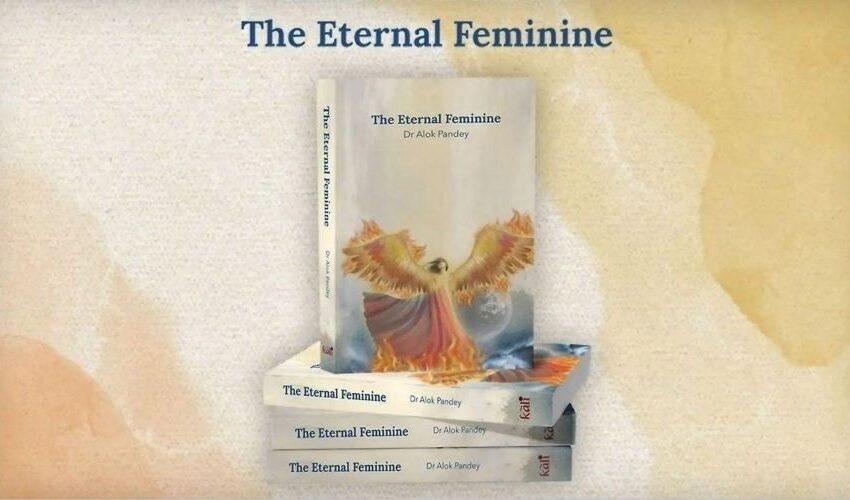
The Eternal Feminine, published by Kali and written by Dr Alok Pandey, is a profound exploration of feminine energy rooted in Indian mythology, ancient legends, and spiritual philosophy. The book reinterprets the concept of womanhood through the lens of divine strength, wisdom, and cosmic power.
Dr Pandey brings to life iconic female figures such as Sita, Draupadi, Savitri, Sati-Parvati, Diti, and Aditi—each representing different dimensions of strength, sacrifice, devotion, and resilience. These women are not portrayed merely as mythological characters but as embodiments of eternal feminine energy that continues to influence human consciousness.
Feminine Power Beyond Myth and Legend
A central theme of the book is the assertion that the feminine principle is not passive or secondary, but foundational to existence itself. Through mythological storytelling, Dr Pandey emphasizes that women symbolize Shakti—the creative force of the universe.
He extends this idea to metaphysical concepts, stating that:
- Deva without Devi is powerless
- Purusha without Prakriti is incomplete
- Ishwara without His Shakti is inactive in creation
These ideas highlight the interdependence of masculine and feminine energies in both cosmic and human existence.
Reclaiming the True Meaning of Feminine Strength
Dr Pandey challenges the perception of women as weak or secondary. Instead, he presents womanhood as a reservoir of wisdom, energy, love, and creative force. According to the book, the feminine is not limited to physical form but represents universal consciousness expressed through creation and transformation.
He also explores how ancient seers revered women as a bridge between the creator and creation, symbolizing divine energy in its most dynamic form.
Integration of Yoga, Tantra, and Indian Philosophy
Beyond mythology, The Eternal Feminine delves into Yoga, Tantra, mantra traditions, and Indian spiritual philosophy. The author seeks to decode India’s mystical heritage and present it as a living spiritual science.
Separate sections on the Ramayana and Mahabharata interpret these epics as deeper psychological and spiritual frameworks rather than literal narratives. Dr Pandey suggests that these texts should be understood at multiple levels—beyond surface storytelling—to uncover hidden philosophical meanings.
Interpretation Challenges and Literary Style
While the book offers rich philosophical insight, it may pose challenges for general readers. At times, the writing shifts abruptly between mythological explanation and metaphysical discourse, making complex spiritual ideas harder to follow without prior understanding of concepts like chakras, subtle body, or integral yoga philosophy.
However, references to Sri Aurobindo and The Mother provide clarity in several sections, grounding abstract ideas in established spiritual thought.
The Eternal Feminine is not just a reinterpretation of mythology but a spiritual inquiry into the nature of feminine energy. It attempts to reawaken respect for the feminine principle as a universal force that shapes existence itself.
Despite its complexity, the book stands as a significant contribution to discussions on spirituality, gender, and Indian philosophical traditions.
