

Nidhi Upadhyay on The Drowning: Real-Life Horror, Tantra, and the Making of a Thriller

Rajkumari Sharma Tankha
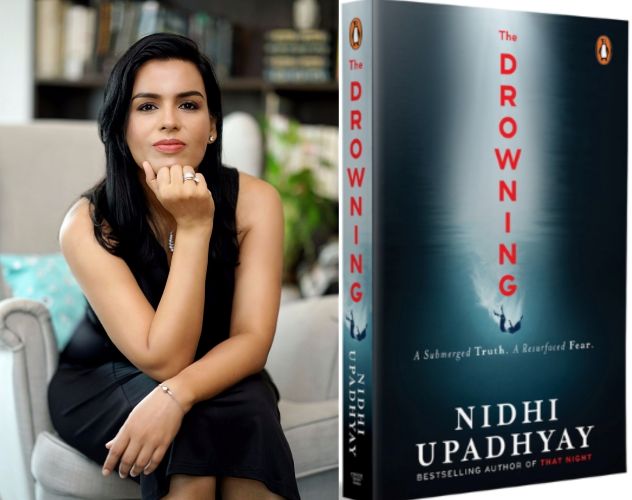
Author Nidhi Upadhyay recently released a thriller The Drowning (Penguin). An engineer by by education, she gave up her successful career as a headhunter to become a mother and a writer. Excerpts from an interview:
How did you get the idea of writing The Drowning? What inspired you to write this story. And how much time did you take to complete this book, cover to cover?
The story behind The Drowning is deeply personal to me, as the book is loosely inspired by a real-life incident in my hometown. It involved a scientist who, in a desperate bid to bring back her dead twins, drowned her neighbour’s three-month-old child.
The tragedy shocked the entire city, especially given that this was an educated, grief-stricken woman working at a prestigious central government institute. It was hard to comprehend how a scientist could be drawn into such extreme actions.
I was a teenager at the time, and witnessing the aftermath of this event opened my eyes to the darker, more complex sides of our society. The themes of black magic, tantra, and the lengths to which a mother might go to reclaim her children left a permanent mark on me. It made me reflect on the psychological toll grief can have and the depths of desperation it can drive people to.
The Drowning is also the fastest thriller I’ve ever written. Within just eight months, I completed everything from the initial story arc to the second draft, and I was already sending it to my commissioning editor. The pace at which the story came together felt just as intense as the book itself.
A crime thriller involving tantra – quite a deadly combination… your take
A crime thriller involving tantra is indeed a powerful and dangerous combination, as it taps into deeply rooted beliefs and dark practices. For me, the best stories are those that reflect society’s realities and feel close to home. The idea of incorporating tantric practices into a crime thriller came naturally, inspired by real-life events.
People in India deeply embed black magic and tantric rituals in cultural beliefs and often use them to control fate or manipulate others. Unfortunately, some individuals exploit these practices for personal gain, leading to horrific crimes such as ritualistic murders, abuse, and exploitation. It’s this intersection of belief and crime that makes the subject both chilling and compelling.
Do you believe in tantric practices? Have you had any experience with these?
My progressive household raised me to see spirituality as a personal, internal journey, so it didn’t expose me to many traditional rituals or customs. I only encountered practices like kala dhagga and nazar utaarna later in life.
However, I do believe in the power of a focused, meditative mind. Because once we place faith in something—a person, a practice, or a belief system—we start to interpret the world through that lens. Our beliefs shape our experiences and perceptions, guiding us in ways we often don’t fully realise.
A personal experience with my aunt and uncle cemented this belief for me. They were searching for their lost son, and my uncle, who had faith in an Aghori baba, was convinced this person had special abilities. To our amazement, the baba accurately described his missing son’s location, what he was wearing, and even when he would return.
At first, we thought it was coincidence, but when their son came back exactly as described, it was hard to dismiss. Since then, I respect the idea that deep meditation and concentration can tap into the mind’s true potential. I think the mind holds the key to experiences that can feel beyond ordinary comprehension.
Are the characters inspired by real life people or are these purely fictional?
The storyline is inspired by a headline, but as the narrative developed, it took on a life of its own. The characters in the book are not based on any real individuals, but they do reflect the struggles of the modern Indian woman.
Whether it’s navigating the challenges of a corporate career, dealing with manipulative mother-in-law dynamics, or facing the emphasis on appearance over talent, the characters’ experiences embody the universal struggles many women face today.
In that sense, while the characters themselves are fictional, their journeys mirror the real-life challenges and aspirations of countless women.
Please share about your early life. Where were you born and brought up, your education, your parents…
I’m a small-town girl, the firstborn and pampered child of working parents. One of the best gifts my mother ever gave me was introducing me to the world of books. It was her way of keeping me busy during those long summer holidays. I discovered Munshi Premchand’s works long before I ever came across Mills & Boons!
My parents always thought my love for literature would lead me down an artistic path, but I was a bit of a rebel at heart, unwilling to follow the career path they envisioned for me. My desire to be financially independent led me to pursue engineering.
To this day, my father thinks I “wasted” my engineering seat, especially since I never ended up working in the field of science as expected. Instead, a series of unexpected events led me into headhunting, and eventually, the writer in me resurfaced.
I Hear You—my first work of fiction is a science fiction novel focusing on genetic modification. That, I think, earned me some respect in my father’s eyes. Finally, a bit of validation for my rebellious choices!
Back then, I had zero interest in getting married, but I did pick the education I wanted, so my father made sure the life partner he found for me was hard to say no to. I think my father wanted to make sure one of his choices would stay with me forever.
Who knew he was planting his “representative” who would eventually lead me down the path my parents always thought was better suited for me? I got married early, navigated the struggles and loneliness of being an expat wife, and eventually built my own home away from home in Singapore. Now, I live here with three boys and a dog who thinks he’s the boss!
whe did you begin writing? Which one was your first article?
Writing has always been my personal form of catharsis. I wrote my first poem at the age of nine, completely oblivious to what being an author really meant.
It was a tribute to my mom, something along the lines of “Mamta, pyar, utsah deti hai maan.” Looking back, it was a mix of clumsy rhymes and terrible spelling, but it marked the start of something significant.
The real turning point, though, came in grade ten. Our teacher assigned us an essay on an unforgettable moment in our lives, and I wrote about my maternal uncle gifting me 100 rupees for a patriotic poem I had written. However, my Hindi teacher accused me of plagiarising from Mahadevi Verma.
At first, the accusation offended me, but my parents saw it differently—they felt thrilled that my writing was so compelling that the teacher believed it came from such a respected source. They felt baffled when I chose science for my high school subjects instead of pursuing writing further.
How and when did you decide to become an author, and how did you move forward?
Becoming an author wasn’t exactly my dream—it was more of a borrowed one. I was perfectly happy scribbling in my diary, content to keep my thoughts to myself.
But my husband, clearly tired of being my sole audience for my never-ending poetry, encouraged me to write something with the goal of publishing it. I think he’d had enough of my “creative outbursts” and wanted to share the agony with the world! 🙂
The journey to publication wasn’t exactly a walk in the park—getting published is far from easy—but I’ve never been one to back down. When my first novel didn’t get a response, I didn’t quit. Instead, I wrote another, because I realized how much I truly loved writing.
Finally, when the stars aligned, That Night and I Hear You both came out within two years of each other. And that made every step of the challenging journey worth it
What is your writing schedule? Any favourite spot or time to write?
I let life shape my schedule. Like Stephen King once said, “Life isn’t a support-system for art. It’s the other way around.” Some mornings, I wake up at four, craving quiet time to write. Other days, I’m at the dining table, watching my kids hurl whatever they can find at each other while the dog races off with his latest prize.
I can’t tell you what works for me, but I know what doesn’t: writing alone in a silent room, shut off from the world. A writing residency? That would be the death of my creativity. I thrive on chaos—it’s what fuels me to craft the messy, unpredictable lives of my characters.
Who is your favourite author and why?
Picking a favorite author is like choosing a star in the sky! My reading journey began with Gaban and Godan by Munshi Premchand, then Mahadevi Verma and Ramdhari Singh Dinkar became key influences.
Isaac Asimov and Michael Crichton hooked me into sci-fi, while Agatha Christie, John Grisham, Jeffrey Archer, and Dan Brown were my companions during my early days in Singapore.
Later, authors like Gillian Flynn, Ruth Ware, Riley Sager, and Lisa Jewell pulled me into new genres, each shaping my path as both a reader and writer.
Which is your favourite book, and why?
And Then There Were None is hands down my favorite book. It was my first real “whodunit,” and I was hooked from the start. For the first time, I realised just how much power an author has to keep readers on the edge with every word. That book didn’t just pull me in; it was the start of a lifelong obsession with mystery thrillers.
What is the best thing about being an author?
The best thing about being an author is that you can kill anyone, create as much chaos as you want, and still be perfectly safe. In fact, the more you kill off your characters, the better you do! Where else in life can you get away with this level of crime without any consequences?
Which book are you currently working on?
I’m currently living through what I’d call a mid-life crisis. One day, I’m updating my CV because the urge to head back to work is overwhelming. The next day, I’m sketching out the story arc for a spy thriller set in the independence era.
And then, the day after that, I’m searching for a course on sustainability and the environment, desperately trying to find something meaningful to do as I watch my brain cells slowly die a slow death.

1 Comment
Kohinoor Woodshire project booking excellent booking in Pune.