

Kashmir Valley Once a Subtropical Paradise, Reveals Fossil Leaf Study

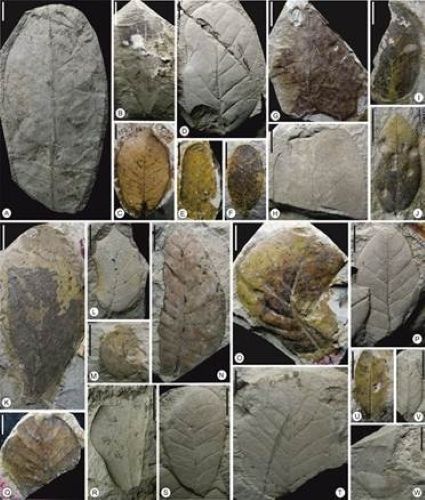
Fossil leaves excavated from the Kashmir Valley belonging to ~4 million years in age.
Team L&M
A groundbreaking study by Indian scientists has revealed that the Kashmir Valley, now known for its cool Mediterranean-type climate, once experienced a warm and humid subtropical environment.
Researchers uncovered this ancient climate history by studying fossilised leaves preserved in the Karewa sediments of the Kashmir Valley. These fossils, part of a collection curated by the late Prof. Birbal Sahni and Dr. G.S. Puri at the Birbal Sahni Institute of Palaeosciences (BSIP), Lucknow, show plant species that no longer exist in the region.
Fossil Evidence Reveals Lost Subtropical Vegetation
The fossil leaves display remarkable diversity and preservation. Many resemble subtropical plant species that are absent in today’s temperate climate of Kashmir.
This striking difference between past and present vegetation prompted scientists at BSIP to investigate how climate and tectonic changes reshaped the region over millions of years.
Himalayan Uplift Changed Kashmir’s Climate
Researchers Dr. Harshita Bhatia, Dr. Reyaz Ahmad Dar, and Dr. Gaurav Srivastava linked this dramatic climate shift to the uplift of the Pir Panjal Range in the Himalayas.
As the mountain range rose, it blocked the Indian summer monsoon from reaching the valley. This led to reduced rainfall, drying of forests, and a gradual transition from a subtropical to a Mediterranean-type climate over time.
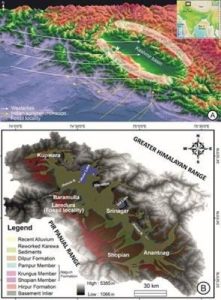
Map showing the location of the fossil locality situated
in the Kashmir Valley
How Scientists Reconstructed Ancient Climate
Using the CLAMP method (Climate Leaf Analysis Multivariate Program), scientists analysed fossil leaf shape, size, and margins to estimate past temperature and rainfall.
They also compared fossil plants with modern species using the coexistence approach, helping reconstruct a detailed picture of Kashmir’s ancient warm and wet ecosystem.
Published Research and Climate Insights
The study is published in Palaeogeography, Palaeoclimatology, Palaeoecology. It highlights how tectonic forces and mountain building played a key role in shaping regional climate systems.
It also shows how Earth’s geological processes influence long-term environmental change.
Why This Study Matters Today
This research is not just a look into the past—it also helps scientists understand future climate risks.
The modern climate change continues to alter rainfall and temperature patterns. Thus, such studies improve predictive climate models and highlight how fragile mountain ecosystems respond to it.
The Kashmir fossil leaf study reveals how dramatically Earth’s climate can change over millions of years. From a lush subtropical paradise, Kashmir became a cooler valley shaped by the Himalayas. This story is a powerful reminder of the dynamic relationship between geology, climate, and life.

1 Comment
Nice that Indian science is busy separating wheat from chaff finding wheat in most! Kashmir was recorded as Rishi Kashyap Valley with Lakes and green ecology in all ancient Indian records .