

GPS & GSP: The SSUHE model
- ASHISH KHOKAR
 Life&More
- 3
- 20 minutes read

These two words – GSP and GPS- are basic to our culture. Indian culture, today or eons ago, is about ancestor worship, elements worship (vedic times), later, idolisation, bhakti, shakti and all progressions. In the art field, especially our abhyaas arts, that’s performing like dance, music, even acting a guru was paramount to learn not only the basic but also the core value systems. It was not merely skill development but craft that over a sustained period of time can become art.
My quest in recent years has been to see both – individuals we can celebrate in our art field or the few really honest – to -good institutions that show humanism and universalism. In this quest, I roam all over India, looking in nooks and crannies to help causes and people. I do that because when we were growing up no one helped us much. Until we were 40 years of age, we were dismissed as bachas! Today Gen Z feels life is over at 40! If they don’t get an award by 40 they think suicidal. I’ve not got any national award nearing 70! Still, I carry on regardless because our work is our best reward. In fact, we have given over 50 awards through attenDance, which are akin to critic’s choice (see full list www.attendance-india.com).
So, in such a search, 40 km from Bangalore airport, which is like 40 km from the city centre – in a village called Muddenehalli – a group of social do-gooders, inspired by Satya Sai, are doing yeoman service to the cause of humanity led by Swami Madhusudan Sai and team. It was inspiring to see the 130-acre campus, with a fully functional Medical College-cum-hospital; 3000 students and over 300 teachers. And a bright, smiling 36-year-old Srinivas Vishwanadh helping the Nada Gurukalam under the directorship of Revathi Ramachandran, well known artiste- administrator.
Ratnas of Bharat – Padma Subrahmanyam and Sonal Mansingh – trudged down uneven but hilly landscape roads to reach it last week to address students who study there in Nada Gurukulam the various arts.
The whole campus actually has over 3000 students from 6th grade to PG! – 75 per cent of which get free education, food and a life many can only dream of but few are blessed with. What makes this unique social service model one with a difference is not the free Annapurna breakfast for 3k+! or Sai Swasthya for villagers getting tele-med inputs, or the over 100 countries in the program from Italy to Fiji. What makes it unique is that it got listed on the social Stock Exchange and touches lives of many that truly the state has failed to reach.
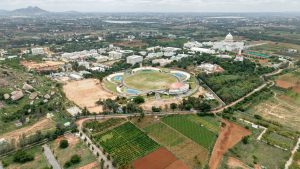
The model is sustainable because it is selfless. It is selfless because it’s a way of life. A life supported by donations from abroad and at home. By keeping admin costs to just one per cent, the maximum sums are thus used for the larger good of students and over 22 rural schools, nine campuses, and three universities! No private foundation that does tamasha events by spending crores in metro India can match the efficacy of this model called the Satya Sai University of Human Excellence. This is true kala seva.
In the 3-day Kalasrotah that unfolded at Nada Gurukulam, thanks to director Revathi Ramachandran’s outreach and inclusivity, there were mai-baaps of sarkari culture dispensation like a dashing Aniesh Rajan on day one with the beauty of Bengal style of dance created by legendary Uday Shankar represented by his bahu Tanushree Shankar. And from Agra gharana came Rita Devi and from Chennai Nandini Ramani, a long-term rep of the legendary Bala amma baani. Yours truly reached the audience through multi layers of cultural exposure worldwide, focusing on family created wealth of Saroja Mohanam Khokar Dance Collection and Archives. That IGNCA, under the able head Dr Sachchidanand Joshi, deemed it fit to sign an MOU with SSUHE shows the level, wisdom and standing of both.
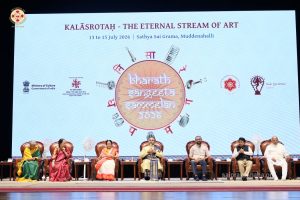
As summarised by its karta-dharta Revathi Ramachandran the inaugural day of Bharat Sangeet Sammelan 2026 – Kalāsrotaḥ laid a profound philosophical foundation for the conference, reaffirming the Indian vision of the performing arts as pathways to self-transformation rather than mere artistic accomplishment.
The speakers collectively highlighted that Indian art has always been a means to refine the intellect, elevate the spirit, and lead the seeker towards the Divine. In His Divine discourse, Swami Madhusudan Sai reminded the gathering that Nāda is the primordial vibration from which creation itself emerged, and that music and dance represent the highest expressions of this cosmic principle. He explained that the very word Bharata embodies Bhāva, Rāga, and Tāla, which together form the soul of Indian artistic tradition. Emphasising that art must become a means of self-realisation, Swami observed that the highest state of an artist is attained when the performer, the performance, and the art become one. He also spoke of the University’s unique mission of making Indian classical traditions accessible to students from rural backgrounds, thereby democratizing the learning and appreciation of the arts.
The technical sessions explored multiple dimensions of India’s performing arts through scholarship, demonstration, and performance. Dr Sumitra Vasudev explained the intimate relationship between Bhāva and Rāga, illustrating how emotional expression breathes life into melody. Drawing upon the Nāṭya Śāstra and Saṅgīta Ratnākara, she described music as a journey from Bhukti to Mukti.
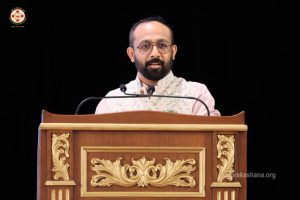
Mai-Baap of sarkari patronage systems, in-charge of many government cultural bodies and institutions under the charge of Ministry for Culture, artocrat Aneish P Rajan traced the evolution of India’s performing arts from the era of temple patronage and royal support to the present-day framework of cultural institutions and government policy. Emphasising the responsibility of the Ministry of Culture in nurturing the arts, he remarked that the very existence of the Performing Arts Division owes itself to the artists of this country. He urged artists not to view government support as charity or favour, but as their rightful entitlement, encouraging them to approach cultural institutions with confidence and dignity. His presentation underscored the shared responsibility of artists, institutions, and policymakers in sustaining India’s rich performing arts heritage.
Dr Ravindra Gururaj Katoti traced the evolution of the harmonium, explaining its structure, versatility, and enduring contribution to Hindustani music. He noted that despite the invaluable contributions of generations of harmonium maestros, the instrument itself remained unrecognised by All India Radio until 1990. While he shared with pride that he became the first harmonium artist to be awarded the prestigious A Grade by All India Radio, he also expressed deep sadness that many of his own illustrious gurus, whose artistry had shaped the tradition, never lived to receive the recognition they so richly deserved.
His reflections highlighted both the struggles and the eventual acceptance of the harmonium as a respected concert instrument in Indian classical music.
Dr Rita Devi demonstrated how creativity flourishes only within the disciplined framework of tradition. Through the Banaras Gharana, she explained the distinction between Khayal and Thumri, emphasising that while Khayal follows a structured format, Thumri allows greater freedom for emotional expression and ornamentation.
The lecture-demonstration by Padma Vibhushan Dr Padma Subrahmanyam on Temple Dance Sculptures and Movement brought together archaeology, sculpture, dance, and the Nāṭya Śāstra. Through rare visual documentation and live demonstrations, she illustrated the correspondence between temple sculptures and the Karaṇas described in Bharata’s treatise. She emphasised that the study of dance must be supported by allied disciplines such as music, sculpture, temple architecture, literature, and painting, thereby enabling a holistic understanding of India’s artistic traditions. Her exposition on the role of the Sthapati as a visionary who reveals rather than merely carves the divine form, and her explanation of the Bhujangatrasita Karaṇa within the philosophy of Naṭarāja, offered profound insights into the spiritual foundations of Indian dance.
The concluding presentation by Nandini Ramani paid a deeply moving tribute to her revered Guru, T Balasaraswati, bringing alive one of the greatest artistic lineages of Bharatanatyam. Through personal reminiscences and rare archival footage, she demonstrated how Balasaraswati’s unparalleled mastery of both music and dance shaped her incomparable artistry. She also clarified that unlike many hereditary dancers of her time, Balasaraswati was not formally attached to a temple as a Devadāsi. Her unique pedagogy, characterised by hours of rigorous, immersive training, continues to inspire generations.
The inaugural day concluded with a sublime Carnatic vocal concert by Sangita Kalanidhi Vijay Siva, whose music exemplified the highest ideals of the Carnatic tradition. Accompanied by Sanjeev Venkataramanan on the violin, Manoj Siva on the mridangam, SR Vikkneswaran on vocal support, and Prasad on the tambura, Vijay Siva captivated the audience with a concert marked by classicism, profound manodharma, and bhāva. Collectively, the presentations reaffirmed that Bharat Sangeet Sammelan is far more than a series of performances and lectures. It is a forum where scholarship, practice, philosophy, and lived tradition converge, inspiring participants to appreciate Indian classical arts not merely as cultural expressions but as profound disciplines of learning, contemplation, self- transformation, and spiritual awakening.
Day Two of Bharat Sangeet Sammelan 2026 continued the intellectual and artistic journey with a series of insightful presentations that highlighted the interconnectedness of India’s temple traditions, performing arts, documentation, rhythm, and creative expression.
The morning session commenced with S. Jayakumar, whose lecture on South Indian Music for Dance – Insights from Temple Architecture demonstrated how temples have historically functioned not only as places of worship but also as vibrant centres of education, music, dance, and community life. Drawing upon the architectural and sculptural wealth of temples such as Chidambaram, Brihadisvara, Darasuram, Hampi, Belur, Halebidu, Kudumiyanmalai, and Arachalur, he illustrated how inscriptions, sculptures, and architectural elements preserve invaluable evidence of India’s performing arts traditions. His presentation highlighted the depiction of the 108 Karanas, ancient rhythmic syllables and musical notation, and the continuity of traditional instruments such as the Panchamukha Vadya, Kudamuzha, Nadaswaram, Tavil, and Periya Melam. He concluded by reminding the audience that these traditions continue to thrive in temples today, beautifully observing that temple is a melody created through rhythm.
The second lecture by yours truly was on the Mohan Khokar Collection – A Living Bridge Between Memory and Creativity and it celebrated the remarkable legacy of Prof Mohan Khokar, whose lifelong dedication to documenting India’s performing arts has become an invaluable national treasure. Tracing father’s journey from being Kalakshetra’s first male student in 1945 from North India to becoming one of India’s foremost dance historians and archivists, he emphasised that preserving archives is as essential as preserving performances themselves. He shared how the internationally recognised Mohan Khokar Dance Collection (valued by a committee headed by UNESCO and Dr Padma Subrahmanyam at seven crores ten years ago), now donated to the Indira Gandhi National Centre for the Arts, Delhi continues to inspire scholars and artists worldwide. Encouraging students to pursue excellence with honesty, humility, and commitment, he reminded them that while institutions impart knowledge, gurus give meaning to life, and that every artist is merely a custodian of India’s cultural legacy.
Concluding the morning session, the Director shared that both the presentations of heritage — one preserved in the living testimony of temples and the other safeguarded through documentation and archives. She encouraged students to make full use of such opportunities by asking questions, deepening their understanding of India’s artistic traditions, and recognising their responsibility in carrying this heritage forward. She also paid tribute to the enduring contribution of Adiguru Rukmini Devi Arundale and the Kalakshetra tradition in preserving Bharatanatyam as a vibrant, living art form.
The afternoon session shifted the focus from history and preservation to artistic practice and creativity. Patri Sathish Kumar, in his presentation The Nuances of Tāla – Beyond Counting Time emphasised that rhythm is far more than mathematical precision. He explained that mastery of percussion demands humility, discipline, patience, and lifelong sādhanā.
The final technical lecture by adroit authority Dr Sriram Parasuram, titled The Art of Manodharma – Creativity Rooted in Tradition explored the delicate balance between tradition and improvisation in Indian classical music. He explained that genuine Manodharma emerges only from a firm grounding in both Lakṣaṇa (theoretical knowledge) and Lakṣya (practical experience). Describing compositions as the foundation upon which creativity is built, he encouraged students to cultivate a personal relationship with every rāga, viewing each as living, divine companion. His interactive demonstration of gamakas, involving students from both the Carnatic and Hindustani traditions, beautifully illustrated how creativity flourishes within the disciplined framework of tradition.
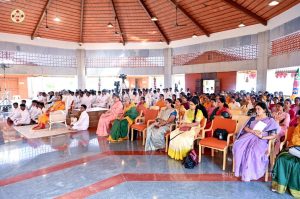
The technical sessions concluded with remarks by Prof Lovely Sharma, Vice-Chancellor of Indira Kala Sangeet Vishwavidyalaya, Khairagarh, who appreciated Bharat Sangeeta Sammelan 2026 as a unique platform that brings together scholars, practitioners, and students in a spirit of dialogue, learning, and mutual enrichment. She commended the organisers for creating an environment where India’s rich musical and artistic heritage is not only celebrated but also meaningfully transmitted to future generations. The second day concluded with a vibrant Tāla Vādya Kutcheri led by Vidwan Sri Patri Sathish Kumar and his ensemble.
The morning technical session commenced with USA returned Rama Bharadwaj, who presented an engaging lecture titled Avataran – exploring the genesis and evolution of Nāṭya. Beginning with the invocation of the Aṣṭadikpālakas, she traced the divine origin of the Nāṭya Veda, explaining how Lord Brahmā distilled the essence of the four Vedas to create the fifth Veda and entrusted Bharata Muni with disseminating this sacred art through the first theatrical performance.
Introducing the concept of Story Theatre, she demonstrated how storytelling, music, dance, and dramatic expression converge to communicate profound ideas. She also explained the significance of the four Vṛttis — the fundamental modes of theatrical expression that underpin Indian performance traditions.
Drawing upon the inspiring legend of Sage Swāti, she illustrated how careful observation of nature became the source of artistic innovation, ultimately leading to the development of rhythm and musical accompaniment. She further described the creation of the Apsaras and the celestial theatre, illustrating how the evolution of Nāṭya was conceived as a divine gift for the upliftment of humanity. The third and concluding day of Bharat Sangeet Sammelan 2026 – Kalāsrotaḥ celebrated the diversity, continuity, and evolving expressions of India’s performing arts, bringing together traditions from Bharatanatyam, Kuchipudi, modern Indian dance, temple theatre, Hindustani music, Carnatic music, and the violin and sarangi traditions.
Dr Veena Murthy Vijay, who presented Kuchipudi – Tradition, Transformation and Timelessness tracing Kuchipudi from its origins as a sacred dance-drama tradition to its present stature as one of India’s eight classical dance forms, she demonstrated how its vitality lies in balancing preservation with innovation. Through lucid demonstrations of the Chaturvidha Abhinaya, dramatic excerpts from Prahlada Charitram and Bhama Kalapam, and Anga Sadhana, she illustrated the technical precision, expressive richness, and theatrical excellence that define the Kuchipudi tradition. She also acknowledged the enduring contributions of Siddhendra Yogi, Vedantam Raghavayya, and Vempati Chinna Satyam in shaping its modern identity.
In her concluding remarks, Dr Revathi Ramachandran encouraged students to appreciate the shared philosophical foundations underlying India’s diverse classical traditions while honouring the distinctive beauty of each art form.
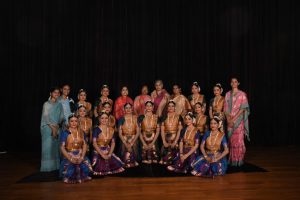
The session then featured an inspiring presentation by ace exponent of Uday Shankar style Tanusree Shankar with her dancers. Through performance and narration, she traced his remarkable journey, highlighting his collaborations with Anna Pavlova, the establishment of the Uday Shankar India Cultural Centre at Almora, and the landmark film Kalpana. She illustrated how Uday Shankar created an original dance vocabulary by harmoniously blending classical, folk, tribal, and theatrical traditions, leaving an enduring legacy that continues to inspire contemporary choreography.
The morning concluded with Dr Madhusudan Kalaichelavan, who presented an illuminating lecture on Earlier Theatre of Bhakti Movement, focusing on the sacred tradition of Ārāyar Sevai. He explained how this rare temple tradition seamlessly integrates music, dance, drama, philosophy, and abhinaya as an offering of kainkaryam to the Divine. Demonstrating the structure of an Ārāyar Sevai performance — from Vāzhi Tirunāmam and the rendering of the Divya Prabandham to expressive interpretation and philosophical exposition — he emphasised that Ārāyar Sevai remains one of India’s oldest living traditions where devotion itself becomes performance.
The afternoon sessions explored the expressive possibilities of melody and musical heritage. Prof Lovely Sharma, Vice-Chancellor of Indira Kala Sangeet Vishwavidyalaya, presented The Language of Rāga Through the Sitar through an engaging lecture-demonstration, she illustrated how the emotional character of a rāga transforms with different tālas, while introducing the audience to the stages of a sitar recital, including ālāp, jod, and jhālā. She beautifully likened the shimmering resonance of the jhālā to the rhythmic pealing of temple bells, revealing its spiritual and aesthetic significance. In her presentation, Gayatri Girish took the audience on A Musical Journey through Kanchipuram – the City of a Thousand Temples. She portrayed Kanchipuram as a timeless confluence of spirituality, music, and culture, describing how the sacred hymns of the Nāyanmārs and Āḻvārs, the sounds of temple bells, Nādaswaram, and Tavil continue to resonate through its ancient temples. She highlighted Kanchipuram significance as one of the Sapta Moksha Puris and the Prithvi Sthala among the Panchabhuta Sthalas, illustrating how devotion and music remain inseparable in the city’s living heritage. The final technical presentation featured Harsh Narayan, who introduced the audience to the expressive world of the sarangi. Reflecting on the legacy of his grandfather, the legendary Pandit Ram Narayan, he shared that his own artistic journey has been inseparable from that of the sarangi itself. His soulful rendition of Rāga Megh beautifully demonstrated the instrument’s remarkable ability to emulate the nuances of the human voice. The technical sessions concluded with remarks by Tanusree Shankar, who encouraged students to make the fullest use of the rare opportunity provided by Bharat Sangeet Sammelan to learn directly from eminent masters and continue their artistic journey with dedication, curiosity, and humility.
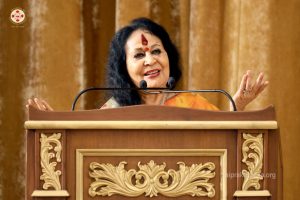
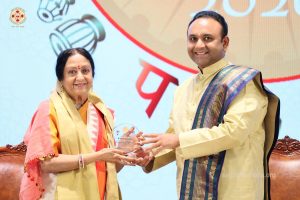
The Valedictory Session celebrated excellence in Indian classical music by conferring the Sri Sathya Sai Sangeeta Shiromani Award upon two legendary maestros — Padma Bhushan Dr N Rajam, whose pioneering Gayaki Ang transformed violin playing in Hindustani music, and Pandit Ulhas Kashalkar, one of India’s foremost vocalists. The Chief Guest of this session Padma Vibhushan Dr Sonal Mansingh, in her valedictory address shared an inspiring reflection on her own artistic journey, through a specially presented video tracing over five decades of her contribution to Indian dance, marking the golden jubilee celebration of her Dance institution. She spoke of perseverance, resilience, and uncompromising dedication to art. Addressing the students, she reminded them that they are blessed to be learning in one of the most sacred environments for artistic education, urging them to make the fullest use of the opportunities bestowed upon them. The Sammelan concluded on a sublime musical note with a violin duet by Padma Vibhushan Dr N Rajam and her granddaughter, Smt Nandini Shankar. Dr Rajam shared with pride that her granddaughter represents the ninth generation of violinists in their family. Their deeply moving recital, embodying the lyrical beauty of the Gayaki Ang, provided a fitting finale to three days of scholarship, inspiration, and artistic excellence. Over the course of three enriching days, Kalāsrotaḥ – Bharat Sangeet Sammelan 2026 reaffirmed that India’s classical arts are not merely traditions to be preserved but living streams of knowledge, devotion, creativity, and self-transformation. Rooted in the timeless vision of Sadguru Sri Madhusudan Sai, the Sammelan inspired every participant to carry forward the eternal stream of Bharatiya culture with scholarship, humility, and dedication.
On this Guru Purnima month (the day falls on July 29) we salute the artistes of India who give India its identity, culture and meaning.
Prof Ashish Khokar is India’s biggest influencer in the dance field without even being on social media! Institutions and individuals benefit from his advice, while young India finds a mentor in him. Fondly called the big brother of the Indian dance field – Anna, is his middle name. 52 books, 5000 articles in mainstream media over 40 years; 85 UGC MA modules for e-pathshala; 50 given awards through 25 years of attenDance. 700 dancers platformed in Alliance Francaise Dance Discourses over 10 years; curating and hosting India’s largest World Dance Day for many years; over a thousand dancers got a chance to dance in NEEMRANA through every Saturday show plus, plus, plus. An encyclopedia on Indian dance history and heritage; a visiting professor to many universities in three continents; top exhibitions and TV shows, he is an expert and advisor to IGNCA, SNA , ICCR and UNESCO. He also served as a panel or council member of the ICCR, HABITAT, Doordarshan, INTACH, AFS and countless private organisations. He has served the field selflessly for 50 years now. India Today has hailed him as the gold standard of Indian dance documentation, archiving and heritage.

3 Comments
Wonderful! Very nicely written.
A superbly curated rundown on the divine performing art forms. This vividly captured narrative can be possible from who else but Ashishji.
Ashish ji’s writing is so witty and exciting to read , and yet so informative. Hope more youngsters take up writing on dance and dance events.