

Savarkar: A Contested Legacy – Vikram Sampath Sparks Debate on History, Ideology, and Interpretation

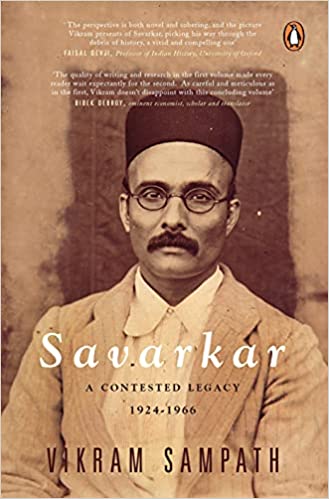
The book is available in hard cover and Kindle edition
Sukriti Tankha
A lively panel discussion marked the launch of Savarkar: A Contested Legacy 1924–1966, the second volume in historian Vikram Sampath’s detailed biography series on Vinayak Damodar Savarkar. Published by Penguin Random House, the book continues the author’s attempt to present a deeply researched, multi-dimensional portrait of one of India’s most debated historical figures.
The event brought together author Vikram Sampath and noted economist Sanjeev Sanyal, with the discussion moderated by Shubhrastha. The conversation explored Savarkar’s political ideology, his transformation over time, and the continuing debates around his legacy in modern India.
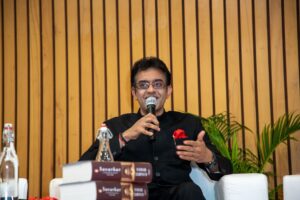
Author Vikram Sampath
Two-Volume Biography on Savarkar
This latest volume follows Savarkar: Echoes from a Forgotten Past (1883–1924), which examined his early life, political awakening, involvement in revolutionary activities, and imprisonment at Kalapani, leading up to his release in 1924.
The second book focuses on his later years, a period marked by ideological consolidation, political controversy, and growing influence in India’s socio-political discourse.
Revisiting a Complex Historical Figure
Decades after his death, Veer Savarkar remains a polarising figure in Indian history. Once an advocate of Hindu-Muslim unity in his writings on the 1857 uprising, Savarkar later emerged as a key ideologue of Hindutva and a critic of Congress politics.
He also served as the president of the Hindu Mahasabha and was controversially accused of involvement in Mahatma Gandhi’s assassination, though he was ultimately acquitted by the court.
Vikram Sampath on Research and Misinterpretation
Speaking at the launch, Vikram Sampath described the book as the result of nearly five years of extensive archival research conducted across India and abroad.
He emphasised the importance of reading Savarkar in context:
“This is a culmination of five years of strenuous research to bring a holistic picture of a much-maligned and misunderstood man. Readers should approach these volumes with an open mind and form informed opinions about Savarkar and his legacy.”
Sampath also highlighted how Savarkar’s ideas are often misinterpreted due to a lack of engagement with original writings. He pointed to lesser-known historical documents, including drafts associated with the Hindu Mahasabha, which reflected complex and often overlooked aspects of constitutional thought.
Sanjeev Sanyal on the Biography
Economist Sanjeev Sanyal praised the work, calling it deeply engaging and accessible:
“It is an excellent work, very well written and extremely readable. These two volumes may be among the best biographies written by an Indian author.”
His remarks underlined the book’s significance not just as historical documentation, but also as a readable narrative for a wider audience.
Debating Savarkar’s Ideology
A key point of discussion was Savarkar’s views on religion and identity politics. Addressing questions on his stance toward Muslims and Christians, Sampath noted that incomplete reading and ideological bias on both sides shape much of the debate.
He argued that Savarkar’s writings, including those associated with the Hindu Mahasabha, reveal a more nuanced position than critics commonly acknowledge. According to Sampath, certain drafts envisioned a political framework where minorities would retain full cultural and constitutional rights, with safeguards against discrimination.
A Continuing Historical Debate
The discussion ultimately reflected how Savarkar continues to occupy a contested space in India’s historical and political imagination. While some view him as a foundational thinker of Hindutva, others see him as a misunderstood nationalist whose ideas require deeper study beyond political narratives.
With Savarkar: A Contested Legacy 1924–1966, Vikram Sampath adds another layer to this ongoing debate, encouraging readers to engage with history through evidence, context, and open interpretation rather than fixed ideological lenses.
