

Bidar: The Ancient Water Heritage City Where History, Spirituality and Sustainability Converge

Madhukar Swayambhu
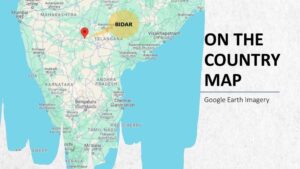
Bidar district is the northernmost part of the Karnataka state in India. The administrative headquarters of district is Bidar city. Geographically, it resembles the “Crown of the State”, occupying its north-eastern end.
It is bounded by Kamareddy and Sangareddy districts of Telangana state on the eastern side, Latur and Osmanabad districts of Maharashtra state on the western side, Nanded district of Maharashtra state on the northern side and Kalaburagi district of Karnataka, on the southern side.
The district is constituted by eight talukas, namely Bidar, Humnabad, Bhalki, Aurad, Hulsoor, Chitgoppa, Kamalnagar and Basavakalyan with Bidar being the headquarters of the district.
Bidar is a historic city having a history of more than 700 years. It has been declared as one of the heritage cities of Karnataka State. Very recently, Bidar has been listed under “World Heritage Watch List” by World Monuments Fund. The Historical or cultural landscape in Bidar is very closely associated with the natural resources of the region.
Located on the northern edge of the deccan plateau rising almost 80 m above the surrounding low-lying area to the north and east and overlooking the Manjira River Valley.

The Legacy of Bidari Craft
The traditional handicraft of the region, deriving its name from the city, is known as “Bidari”, which has yet another story to tell about the historicity of the traditions here.
While most historians dedicate the art to the 14th century Bahamani Empire, but if you delve a little deeper into the art, you would realise that the it is a much older tradition, because this metal work is done an alloy of copper and zinc metals, in the ratio 1:16 by means of casting, but the very art & knowledge of zinc extraction was limited to India till the British invasion.
All streams of Science & Archeology regard and respect India as a land of metallurgy and alchemy. The “Damascus Steel” of India was exported across the globe even till Mughal Era, then how could the zinc-based alloy work be an import from Iran?
From the Indian History perspective or the itihas perspective as well, we have two of our scriptures or the epics dedicated to itihas namely Ramayan and Mahabharat, which have been known to be the most scientific recordings of the Indian history with tons of archeological evidences spread across the country.
Papnash Shiva Temple and Lake
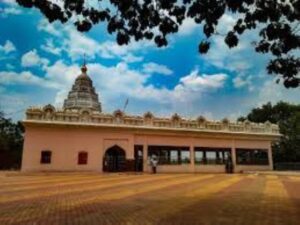
Papnash Shiva Temple is one of the most popular temples of the Bidar city. It is believed that Prabhu Ram while returning from Lanka installed a shivling in this temple. This temple is also known as Pap Vinashi Teerth. It is believed that a visit to temple and a dip in the Papnash pond, located just down the steps of the temple, destroys all sins. This temple is located in a valley.
>According to the locals, the idol of this temple was installed by Lord Rama on his way back to Ayodhya from Lanka. During Shivaratri thousands of pilgrims and tourists visit this temple. There is a large shivling to which pooja can be offered directly. During Shivaratri a fair is organised.
The surroundings of the temple are also quite captivating with a natural spring flowing into a pond Papnash, from here the water reach the lake behind the temple by virtue of gravitational force, forming the 25.44 acres picturesque Lake Papnash.
Ramayan Connection and Spiritual Significance
The reference of Bidar’s Papnash Mahadev Temple is found in Ramayan: When Shri Ram was returning to Ayodhya after a victorious battle in Sri Lanka, he took a halt in the region, and the established the Papnash Mahadev shivling, due to which the natural water stream got created leading to the formation of the Lake Papnash.
The key ideology behind the formation of the waterbody was “repentance towards the furious war” and “washing away the known or unknown sins” committed by the entire Vanar-army, as well as Ram, Lakhshman and their chieftains.
With Mahadev himself being a witness and forgiver, all the sins had to be washed up before reaching the holy city of Ayodhya. That has been the rich heritage of the city of Bidar, its natural resources and culture.
Water at the Heart of Bidar
Water has always been at the center stage of the affair in the Bidar, be it the ancient India, medieval history during Bahamani Kings or even post-Independence.
The quality of water, water sheds, water structures, and water resources have always been important in Bidar. Irrigation systems, canals, surang-bhawi systems, karez systems, baolis, step wells, lakes, ponds, and rivers have all been subjects of interest. Not just for the rulers of the city, but also for the common people.
For practical purposes, we can call it a “Water Aware” city, even before the present “water stress” happened in the country. The key reason behind the awareness is the very fact that Bidar is a hill-top city situated on the Deccan Plateau. The scarcity of the natural water resources comes unsurprisingly due to the geographical situation and the agroclimatic zone of the city.
The Coordinates of Bidar being 17.912°N, 77.520°E, with an elevation of 710 m (2,330 ft) above the sea level, it lies at a central position of the deccan plateau. The upper crust of the plateau is of laterite, a soft porous rock with limonitic surface.
This crust varies in depth from 100 ft (30 m) to 500 ft (150 m) and rests on a bed of trap, which is of much harder texture and less pervious to water. This logically causes Water availability to be limited, and hence the “awareness” is obvious.
The Unique “Surang-Bawi” System or Karez
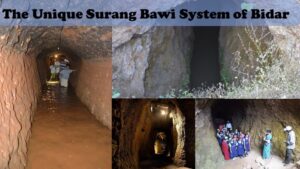
Karez or the Surang Bawi, is an underground irrigation canal. It is an aqueduct or a tunnel that is deep enough to reach the natural aquifers. This travels horizontally towards the ‘Karez Mouth’, which is a lower line region. It has the tunnel that manages a natural gravitational pull for the water to flow towards it.
This aqueduct is impeccably designed to have vertical shafts or air vents connecting to the surface. These serve as fresh water wells for the communities living on the surface.
It normally runs from a higher elevation to a lower elevation. The first shaft that is sunk in higher elevation at source point of water is called ‘Mother Well’. The underground tunnel or aqueduct can run several kilometers to open at lower elevation. The opening of the Karez is called ‘Karez Mouth’.
The tunnel section is referred to as ‘Karez Gallery’. The Karez Gallery cuts the water table and allows groundwater to get accumulated and carried down slope. Though there is distribution mechanism developed at Karez mouth, the air vents are also used as open wells for extraction of water.
Research and Revival of the Karez System
There’s wonderful research done by Dr. V Govindankutty, Assistant Professor (Geography), from Government College, Chittur. IT was published on www.urbanupdate.in , in January 2016. The professor has been doing in PhD research on the “Surang-Bawi” system in Bidar.
Based on the research done by Dr. V Govindankutty, the District Administration began revival project on May 22, 2015. Water diviner and Surangam practitioner form Kasaragod, Kerala, Shri Kunjambu initiated the cleaning process of Karez system. He trained the local labour in cleaning the Karez Gallery by maintaining the 1/1000 slope for gentle flow of water.
Restoring a Forgotten Water Legacy
This was important as any change in slope would have led to erosion and gully formations in Karez Gallery. The cleaning process was carried out manually like in the bygone era when it was constructed. On September 15, 2015 a miracle happened. The Naubad Karez started functioning with a rate of flow of 70 liters per minute. And the age-old system was successfully considered “Restored”.
The 1977 – Gazetteer of Karnataka State, says , “A scheme for providing protected water to the town was started in 1952. Wells situated at three places – Chitta, Chidri and Papnash – were the main sources of water. In 1967, a comprehensive water supply scheme, using the river Manjra as a source of water, started. It was completed in 1974 at an estimated cost of Rs 50 lakh.
Madhukar Swayambhu is known for his career in the IT communication network industry spanning over two decades. He is also the inventor of Cownomics® Technology. A TED speaker, he received several national and international awards. He was honoured with the Water Hero award by the Union Ministry of Jal Shakti. He has also been recognised as the globally No. 2 author by Smart Water Magazine, Spain.
