

Daayra Movie Review: A Promising Story That Loses Its Way in Execution
- ENTERTAINMENT FILM REVIEW
 Life&More
- 0
- 6 minutes read

Rajkumari Sharma Tankha
There are stories that raise uncomfortable questions about justice, morality and the limits of the law. Daayra falls under this category. It takes up a compelling subject and attempts to explore the conflict between the judicial system and instant justice.
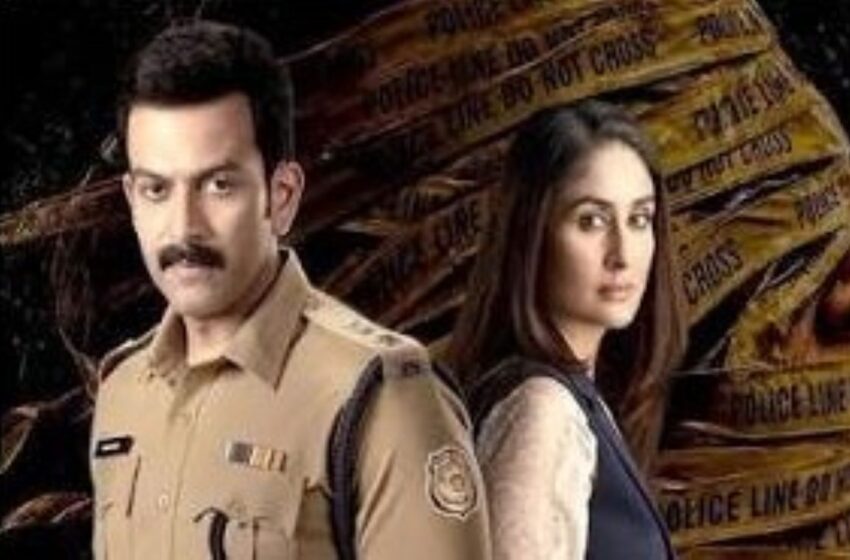
The movie revolves around two Deputy Commissioners of Police – Kareena Kapoor Khan (DCP Ajooni Kohli) and Prithviraj Sukumaran (DCP Raman Kumar) – who find themselves on opposing sides of the law while investigating a brutal crime – gang rape and murder of a young girl Ragini Pujari (Pragati Mishra). Their contrasting approaches to justice is what the story is all about. Such a strong subject needs an equally strong script writing and screenplay as also well-developed characters. The makers failed on both fronts. As a result, the execution falls flat- it is neither coherent nor engaging. Dull is what describes the movie the best.
The makers have touched each of the three very valid and evergreen subjects viz long-drawn court cases, police accountability or the lack of it, and public anger over gang rapes and killings – but in such a sketchy manner that none of it leaves any impact on the viewer.
I, for one, kept waiting for the film to pick up pace, deliver a compelling twist or make a point that would stay with me. But it just dragged on, and then, quite abruptly, ended. And, I was left wondering what the makers wanted to show?
A promising premise, a weak screenplay
One major issue with Daayra is that it doesn’t have a focussed narrative. The film shows a nuanced examination of two opposing philosophies: faith in the legal system versus the belief that extraordinary crimes demand immediate retribution.
However, instead of developing this conflict with clarity and conviction, the screenplay moves between perspectives – and there no depth with any of the two perspectives. And, this is what scatters the narrative.
The first half off the film shows the victim’s family, the investigation and the circumstances surrounding the crime. I felt some of this background was necessary, but many overly stretched sequences could have been shortened. These long sequences hampered the pace of the film, which took too long to arrive at the moral conflict. Moral conflict, I feel, is something which should have driven the story from the very beginning.
Further, each DCP has a separate narrative, which makes the film disjointed – as if there are two different stories rather than these being two parts of one cohesive story.
Characters that needed more depth
Kareena Kapoor Khan plays DCP Ajooni Kohli, investigating a police encounter and identifying wrongdoing within the force. The daughter of a judge (Kanwaljeet Singh), she is familiar with the workings and limitations of the judicial system. I expected this character to have a layered understanding of justice, particularly in cases involving sexual violence. But none exists.
Her motivations remain frustratingly unclear. Why does she approach the case with such an insistence on procedure and human rights? What is her personal understanding of the crime and its aftermath? The screenplay gives almost no insight on her experiences that shaped her convictions.
Worst of all is her performance. Why is she shown always smiling – even during the tense investigation. It feels funny. Actually, rather than a senior cop, she comes across as a glam doll in finest of clothes. Kareena should have taken some learning from Shefali Chhaya’s character in Delhi Crime web series. That’s how a woman cop should look and behave. A woman cop with a constant smile plastered on her face makes everything look trivial.
Prithviraj Sukumaran, who portrays the other side of the moral argument, has enacted his role far better. Hit by the pain of the rape victim’s mother (played by Kshitee Jog), when she says – this is just the beginning, I don’t know for how many years will we be called to the courts – he decides to take the issue in his hands, and deliver justice as in kill the criminals, one of who is juvenile.
The makers have also touched upon the Nirbhaya’s gang rape case here, showing the juvenile who was tried before a Juvenile Justice Board under the Juvenile Justice Act then in force, and given three years detention term for reformation. Again a good topic, but not developed at all.
The missing moral dilemma
The most disappointing aspect of Daayra is that it raises a significant ethical question without examining both sides of it with any conviction.
The failure of the judicial system is presented more comprehensively than the opposing argument against extrajudicial justice. And then, the final judgement has been left to the audience. There is nothing wrong in that – some of the finest crime dramas have done that before. But, here it falls flat because neutrality cannot come at the cost of narrative clarity. A filmmaker can surely present opposing viewpoints without endorsing either, but only after exploring each deeply. Not the case here.
A missed opportunity
Meghna Gulzar has demonstrated her ability to handle complex crime stories with films such as Talvar. I wish she could have brought in the same gritty realism, attention to investigative detail and layered storytelling to Daayra.
The subject could have benefited from a tighter, more grounded treatment, perhaps with the investigative intensity and realism associated with crime dramas such as Delhi Crime. More attention to character histories, sharper dialogues and a stronger narrative structure could have bettered the film. Alas, nothing of the sort happened. So, in the end, what shines through the film Daayra is its uneven pacing, underdeveloped characters and confused narrative.
