

Hemis by Madhu Tandan: A Reflective Novel on Love, Loss and Inner Awakening

Rajkumari Sharma Tankha
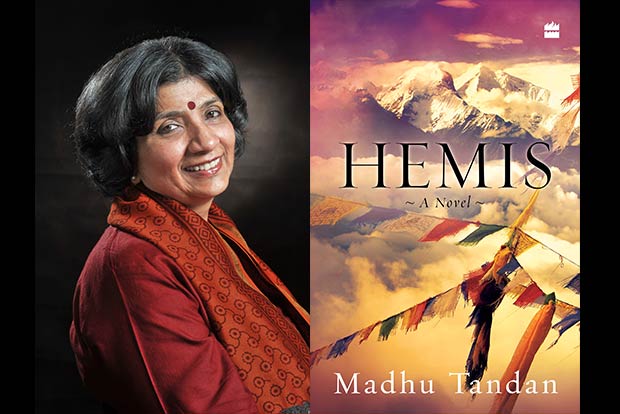
At first glance Hemis, Madhu Tandan’s latest novel, appears to be a simple story of marital discord. To escape daily fights with his wife Swati, the protagonist Ajay plans a trip to Ladakh. He believes the trip will give him breathing space. It will also help him reflect on his relationship. But a few pages into the book, the story changes. It is not a simple love story. It is much more than a couple facing a midlife crisis.
A Marriage Under Strain and a Journey to Ladakh
Set mostly in Ladakh, the story shifts to the city only when Ajay recalls his past life. He remembers his close friendship with colleague Akanksha. And, recalls falling in love with Akanksha’s friend Swati. Afterwords, he reflects on life after marriage. A few innocent comments later, Swati begins to suspect that Ajay is cheating on her with Akanksha. Akanksha also happens to be Swati’s childhood friend. She had introduced Swati to Ajay.
Ajay remains certain of his fidelity. Still, the suspicion damages his marriage. With his relationship at risk, he decides to go on a trek in Ladakh. The region then experiences severe floods. He gets stranded. He is forced to seek shelter in a remote monastery, Hemis Monastery. Here, he begins to understand the meaning of love and life. The author uses Ajay’s conversations with the monastery abbot Rigzin and another inmate Anna to explore deeper questions of existence.
Interwoven Stories of Loss, Faith, and Identity
The novel is not just one story. It carries multiple threads woven into the main narrative. Through Rigzin’s life, Tandan tells the story of Tibetans who are forced to leave their homeland. The Chinese Army enforces control over Tibet, pushing many into exile in India.
Through Anna, a research scholar, the author explores grief and intellectual obsession. Anna searches for a lost manuscript on the “missing” years of Jesus Christ. She believes it could create upheaval in the Church and among Christians. The manuscript claims Jesus spent those years in India, learning from Hindu scholars. The book also raises questions about crucifixion and resurrection.
The flood brings three very different people together. Each of their lives revolves around an absent “other”. The abbot and Anna try to help Ajay understand his situation. In the process, all three gain insight into their own lives.
Reflections on Life, Pain, and Inner Truth
Hemis explores life and its many complexities. It does not become preachy or dull. The author shares insights through conversations between the abbot and Anna. They speak about life situations and human suffering.
Nothing is insolvable, you just have to persist. Pain comes from the body, but suffering stays in the mind. No person or event has betrayed him; his own expectations have. Happiness can only be found within.
Lines like these make the reader pause and reflect. The book connects with individual lives and everyday dilemmas. It suggests that solutions do not always lie outside. One must connect with the heart to understand what the universe is trying to say.
A Simple Style With a Flawed Protagonist
The book is written in simple and lucid English. It appeals to readers who enjoy reflective fiction. It especially suits those exploring questions about life and human relationships.
However, the ending feels unsatisfying. Ajay returns to the monastery. After four weeks there, he abandons his wife, whom he claims to love. Ajay also appears inconsistent. He is emotionally attached to Akanksha. He marries Swati after being “floored” by her. When Swati suspects him, he leaves for Leh. There, he meets Anna and chooses a different emotional path.
