

A Midnight Adieu During Indo-Pak Partition 1947: A Harrowing Account of Human Suffering

Rajkumari Sharma Tankha
I have read quite a few books on the India-Pakistan Partition and the immense human suffering that followed. Over time, I have become familiar with its nightmarish details. Yet, every new book on the subject tempts me—hoping for a new perspective, a different story, or perhaps some rare moments of hope.
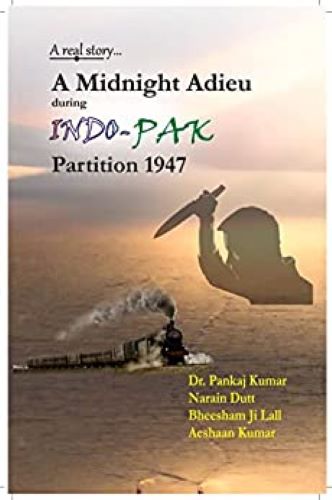
I picked up A Midnight Adieu during Indo-Pak Partition 1947 with the same expectation. Unfortunately, this book too does not offer relief from the grim realities of Partition. Instead, it revisits the brutal truth of the era—marked by violence, displacement, and the failure of political and social systems to prevent widespread chaos.
First-Hand Testimonies of Partition Survivors
What makes this book particularly powerful is that Dr Pankaj Kumar does not rely on fictionalized accounts. Instead, he documents real-life testimonies of people who experienced the partition horrors first-hand.
Among them is his nonagenarian father, Narain Dutt, who recounts deeply traumatic experiences of 1947. His narrative reveals the massacre, rape, and looting that took place as neighbours turned against each other during the Indo-Pak Partition. The emotional weight of his memories is overwhelming and deeply unsettling.
The book also highlights how violence was not limited to civilians alone. In a tragic account, Narain’s father, Dr Paras Ram, was killed by the Baloch unit of the Pakistan Army, reflecting the scale of state-involved violence during the Partition.
Questions of History, Leadership, and Responsibility
The narrative raises difficult questions about leadership and historical responsibility. It challenges readers to reflect on whether leaders of the time—including those in the Indian National Congress and figures like Lord Mountbatten—fully understood the consequences of Partition.
Narain Dutt’s reflections question the assumptions made during the division of the country: Was it realistic to expect peaceful coexistence immediately after such a division?
Could the leaders have foreseen and prevented the scale of communal backlash?
The author leaves these questions open for readers and encourages critical reflection on one of the most defining events in South Asian history.
A Warning Against Communalism and Forgotten Lessons
At its core, A Midnight Adieu During Indo-Pak Partition 1947 is not just a historical account but a warning against religious fanaticism, hatred, and communal division. It urges governments and societies to take firm action against forces that spread disharmony.
Through the story of one family, the book reflects the suffering of millions who lived through Partition. It becomes especially relevant today as India marks 75 years of independence, reminding readers of the immense human cost behind the birth of two nations.
The book is a sobering reminder that when communal tensions escalate, it is always the ordinary people who suffer the most. It calls upon readers—regardless of religion or political belief—to remember the past and safeguard unity in the present.
