

Inside All Stray Dogs Go To Heaven: A Conversation with Krishna Candeth

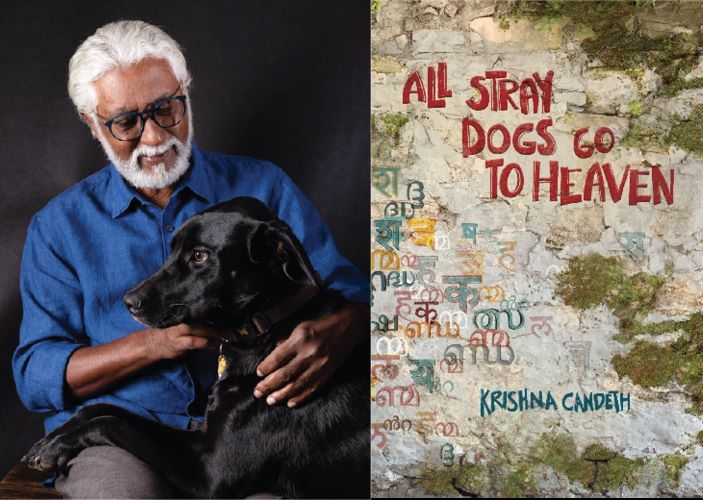
Author Krishna Candeth and his debut work All Stray Dogs Go To Heaven
Rajkumari Sharma Tankha
All Stray Dogs Go To Heaven (BluOne Ink) is the debut novel by filmmaker-cum-poet Krishna Candeth. Written by the Kerala-born, Colombia-based author, the book explores themes of love and friendship, dreams and reality, through multiple perspectives that keep readers deeply engaged. In this exclusive interview, Krishna Candeth shares insights into his writing journey, storytelling approach, and views on society.
When did the idea of writing All Stray Dogs Go To Heaven come to you? How long did it take to complete the novel?
In the Preface to the novel, I talk about how raising funds for a film is closely linked to a peculiar but necessary skill—what I call “bullshitting.” While most of us possess some version of it, mine proved inadequate to fund the project I had in mind. During one such lull in fundraising, I decided to abandon the film and write a novel instead.
I had carried fragments of this story in my head for years. When I began writing, I fleshed out those ideas first. Since the novel follows an episodic structure, the real challenge was finding a thread that could connect different timelines, emotions, and character arcs. It took me over four years to write the book, and almost as long to get it published.
The title All Stray Dogs Go To Heaven is intriguing. What inspired it?
I’ve spent a lot of time observing stray dogs. Some carry a quiet confidence, while others live in constant fear. Once, while filming in Varanasi during a beautiful sunset, I noticed a group of stray dogs peacefully resting near a ghat. Just as we were about to shoot, a tea shop owner chased them away, saying they would ruin the frame.
That moment stayed with me. The “stray dogs” in the title also reflect the characters in the novel—people wandering through the backstreets of their own emotions and imagination. As one character says, they may have a roof over their heads, but not over their feelings.
As for pet dogs—well, the line between pet heaven and pet hell is quite thin!
Your book touches upon gender inequality. What is your perspective on patriarchal vs matrilineal societies?
Despite constitutional guarantees, gender inequality in India remains deeply entrenched. Women still face limited access to education and employment, and many internalise the belief that they should remain subservient to men—an outcome of long-standing patriarchal conditioning.
The society depicted in my novel is not matriarchal but matrilineal, where inheritance passes through women. However, even in such systems, men often retain control over major decisions outside the home.
While some progress has been made, change remains slow. Even in Kerala, where women excel in education, female unemployment remains alarmingly high.
How was your experience of transitioning from filmmaking to writing a novel?
At a fundamental level, both mediums share similar challenges. In filmmaking, you decide what to show; in writing, what to leave unsaid. Both rely heavily on how information is revealed to the audience.
Storytelling, whether visual or literary, is about rhythm, tone, and intuition. It cannot be rushed or formulaic. I prefer narratives that unfold organically rather than those that rush towards a predetermined ending.
You published your first novel at 70. How fulfilling has this journey been?
It has been immensely satisfying. While I had written poetry earlier, this was my first long-form work. Completing a novel required sustained focus—something I had struggled with in the past. Staying committed for over four years and bringing the project to completion is something I truly value.
Who are your creative influences?
Every artist carries a unique world within them. While we are influenced by global art and cinema, it’s essential to adapt those influences into our own storytelling language.
I admire filmmakers like Ozu, Kurosawa, Orson Welles, Bresson, Fellini, and Paradjanov. However, the true inspiration lies in shaping these influences into something personal—much like Satyajit Ray did.
In literature, Milan Kundera’s The Unbearable Lightness of Being and Gabriel García Márquez’s One Hundred Years of Solitude left a deep impact on me.
How does filmmaking in India compare with the US and UK today?
Indian cinema has evolved technologically, but perhaps at the cost of emotional depth. Earlier, filmmakers took pride in storytelling despite limited resources. Today, while films are visually polished, they sometimes lack emotional resonance.
Globally, filmmaking itself has changed. Most films are now shot digitally, and traditional celluloid is rapidly disappearing. Even smartphones now offer “cinematic” modes—a stark contrast to the artistry of traditional filmmaking.
What can readers expect next from you?
I continue to write poetry and develop ideas for screenplays, although funding remains a challenge. I am also researching for another novel, though its final form is still evolving.
How do you spend your free time?
I live in Colombia on land that was once cleared for flower cultivation. I now spend time reforesting it—learning about native plants and restoring the ecosystem. Gardening has become a deeply fulfilling process for me.
Any message for senior citizens?
First, I dislike the term “senior citizens”! Labels aside, my advice is simple: don’t worry too much about what others think. Stay curious. Learn new things. Let go of old prejudices. Read poetry, plant a garden, and embrace life with a sense of wonder.
Sometimes, as I learned from an elderly man I once met in New York, it’s perfectly fine to “just hang around.” There’s a quiet joy in that.
