

Judy Balan on Why Am I Like This and the Power of Psychological Astrology

Rajkumari Sharma Tankha
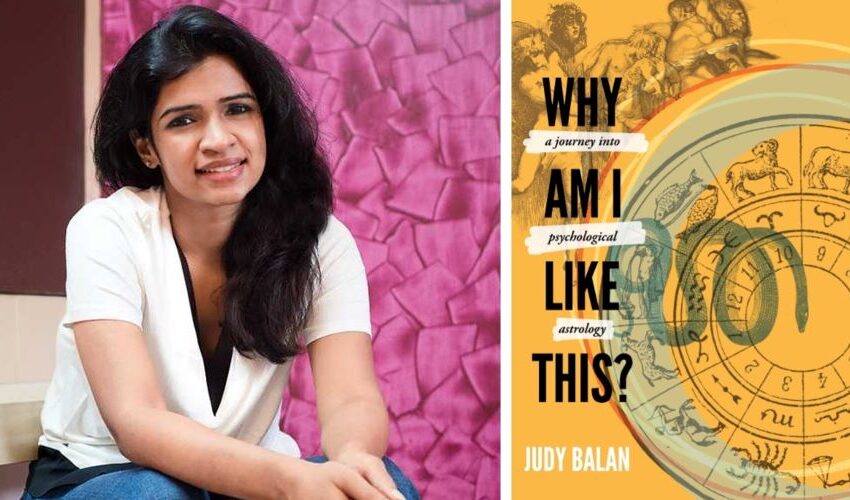
A fascinating story of self-discovery, Judy Balan’s new book Why Am I Like This (Simon & Schuster India) explores astrology, Jungian psychology, mythology, and her own life experiences. The book offers a fresh and insightful take on psychological astrology for modern readers.
Mother to a 17-year-old girl and two Retrievers, the author is a Consulting Psychological Astrologer based in Chennai. “I’ve lived in the same city (Chennai) all my life (hence the compulsive need for all this stimulation: If I can do nothing about where I actually live, then I’ll just have to turn my head into an interesting place and live there sort of thing),” she says, speaking about what inspires her writing. Excerpts from an interview:
When did the idea of penning Why Am I Like This strike and how did you go about writing it?
My editor pitched the idea to me in 2018 when I first started out as a Consulting Psychological Astrologer. But I gave it a couple of years before I decided to take it on. So I signed the book in January 2020 but struggled to write it for almost three years.
It wasn’t fiction, so it’s not like I had to wait for inspiration. And it was a subject I knew well. I loved the idea of the book and desperately wanted to write it and yet I just couldn’t.
Though it was always meant to be a book for the absolute beginner, I found myself unconsciously trying to please the academic. So it was a lot of writing, re-writing, whingeing about never being able to write again, until I decided to make it part memoir—as my editor had initially suggested.
I was very resistant to the idea, especially given the parts of my story that emerged in the writing. But I was also exhausted from the dry spell, so I decided to get out of the way of whatever wanted to be written. After that, the process became much easier.
You call it an in-depth beginner’s guide to psychological astrology. Tell us more about it.
Psychological astrology, as a recognised branch of astrology, has been around since at least the 1970s. It is a synthesis of astrology and depth psychology, particularly Jungian psychology (after Swiss psychiatrist Carl Jung), where the focus is on understanding the unconscious mind.
Seen through this lens, psychological astrology offers a deeper and more meaningful way of understanding astrology—far beyond sun signs and Mercury retrograde, which popular astrology often focuses on.
It involves studying the natal chart—an astronomically accurate map of the sky at the exact moment and place of birth—as a map of the psyche and an indicator of a person’s potential wholeness.
Even predictive astrology, when viewed psychologically, is less about “what will happen” and more about understanding the meaning of a particular phase and navigating it consciously.
Prior to this, you wrote parodies of Chetan Bhagat’s novels like Two Fates: The Story of My Divorce and Half Boyfriend. What inspired these?
Two Fates was my first novel, and I had no idea what I was doing. It started as a random thought—a joke, really. I blogged about it, people asked me to write it, so I did.
I didn’t expect to get published, so like most good things in my life, I just stumbled into it. As for Half Boyfriend—I’m not the sort of person who has regrets, but I do regret that (sobs). So if it’s alright with you, I’d rather not talk about it.
How challenging is comedy as a genre? Who inspires your writing?
I don’t think I ever consciously chose to write comedy. It just emerged as a voice in my writing. I’ve always found things funny in retrospect, so it naturally shows up on the page.
Interestingly, this voice appeared during a very difficult phase in my life. When I began writing a blog during what felt like rock bottom, the voice that came through was light, honest, and unexpectedly funny.
It felt like a gift from the unconscious—the ability to laugh at myself and find humour even in painful experiences. It was deeply healing and liberating, and I held on to it.
As for inspiration, it wasn’t deliberate. I’ve always enjoyed comedy in books and films, and perhaps that naturally shaped my writing style.
You were an advertising professional. What led you to switch to full-time writing?
I was in and out of advertising jobs, so it wasn’t a clean break. My decisions at the time were largely influenced by undiagnosed ADHD. I was impulsive, disliked being tied down, and was fortunate enough to explore different paths.
That said, I wouldn’t recommend this approach to someone who values stability. I simply needed the excitement of new beginnings more than predictability, so I embraced the uncertainty.
Are you currently working on a new project?
Yes, though not actively writing at the moment. I have an idea brewing—which is always the most exciting stage—but recent life transitions and responsibilities are slowing things down.
That said, I almost prefer it this way. I need it to be something I have to fight for, or I may never fully commit to it.
