

A treat for non-Bengali lovers of Saratchandra’s works

Rajkumari Sharma Tankha
I have always loved reading classics. Over the years, I’ve immersed myself in the works of Rabindranath Tagore, Saratchandra Chattopadhyay, Munshi Premchand, Amrita Pritam and Mahadevi Verma. Among them, Saratchandra remains my absolute favourite. His storytelling, especially the subtle romance woven into his narratives, touches the deepest chords of my heart.
My journey with these literary giants began when I was around 14, in Munirka, Delhi. Our neighbours—an endearing family led by Vijay uncle and his parents—played a pivotal role in shaping my reading habits. Their home housed a magnificent wall-length almirah filled with books. Until then, my reading world revolved around comics and children’s magazines like Nandan, Chandamama and Champak, or occasional titles from Enid Blyton, borrowed from a small lending library.
That library—Omi Book Shop—charged just 50 paise a day. Every evening, I would eagerly ask my mother for that small coin, just to get lost in a new story.
But everything changed when dadiji, a retired professor, noticed my silent longing for her collection. One day, she handed me Badi Didi by Saratchandra. That moment marked the beginning of a lifelong literary bond. Book after book, she shared her treasured collection with me—and in doing so, gifted me a world far beyond my years.
A Translation That Preserves the Soul
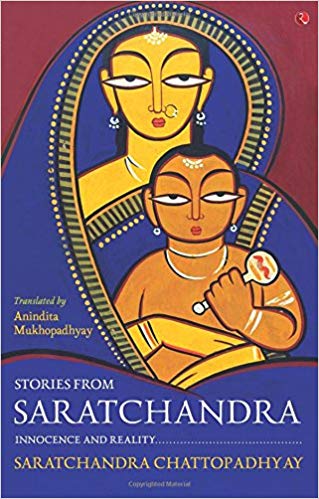
Coming to Stories from Saratchandra: Innocence and Reality (Rupa Publications) I approached this English translation with some hesitation. Having read Saratchandra extensively in Hindi, I wondered whether the emotional depth and cultural nuances would survive the transition.
To my delight, Anindita Mukhopadhyay does an exceptional job. Her language is fluid, and more importantly, she preserves the soul of Saratchandra’s storytelling—a rare achievement in literary translation.
Themes: Innocence Meets Harsh Reality
The book features 12 stories, thoughtfully divided into two sections:
-
Innocent childhood tales that evoke nostalgia and simplicity
-
Social narratives that confront deeper issues like casteism, poverty, and emotional bonds between humans and animals
Saratchandra’s brilliance lies in his keen observation of society—something that shines through vividly in every story.
Highlights from the Collection
One of the standout stories, Laalu-One, is both humorous and unsettling. Laalu’s mischievous antics, especially towards his mother and tutor, are amusing yet carry an underlying sharpness.
In contrast, stories like Childhood Memories and Haricharan delve into darker territories—exploring themes of social inequality, humiliation, and religious prejudice. These narratives can feel heavy, but they reflect the stark realities of the time with honesty and depth.
Final Verdict
Stories from Saratchandra: Innocence and Reality is a fine collection that balances warmth with realism. Backed by a sensitive and skillful translation, it makes Saratchandra’s timeless stories accessible to a wider audience.
For readers unfamiliar with Bengali or Hindi, this book is nothing short of a treat. And for long-time admirers like me, it is a nostalgic return to a beloved literary world.
