

TWO BODIES, ONE CONSCIOUSNESS
- ART & CULTURE SANDIP SOPARRKAR
 Life&More
- 0
- 6 minutes read


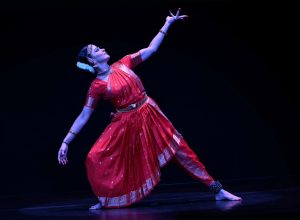
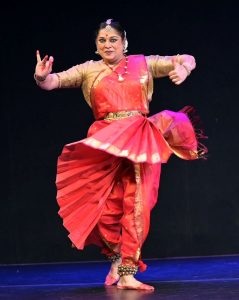
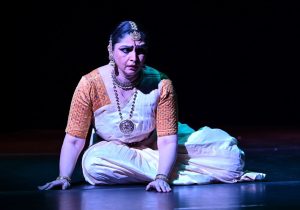
At Pravaha, a festival dedicated to showcasing and premiering new productions, Shringara Bhakti 2.0 emerged as a deeply reflective and aesthetically layered dance feature. Show at NCPA Mumbai was conceptualised and curated by Dr. Usha RK, an arts consultant with over four decades of experience, the production explored the interdependence of śṛṅgāra (love) and bhakti (devotion) through four powerful feminine archetypes: Sita, Meera, Kamakhya, and Rati. Dr. Usha RK shares the philosophy, process, and provocations behind the work:
What inspired you to conceptualise Shringara Bhakti 2.0?
Pravaha is a space that encourages new thinking and fresh premieres, so I felt it was the right platform to revisit and expand an idea that has been maturing within me for years. Earlier, Shringara Bhakti 1.0—with four male dancers—was presented at the Nalanda Dance Centre. That version sowed the seed. But I wanted to go deeper, especially into the feminine experience of love and devotion.
Whenever I watched young dancers perform śṛṅgāra on stage, I often felt that it was exaggerated, ornamental, sometimes even externalised, while the subtle undercurrent of bhakti was missing. It made me question: aren’t śṛṅgāra and bhakti two sides of the same coin? Can there be true love without devotion? Does śṛṅgāra elevate into bhakti, or does bhakti already encompass śṛṅgāra within it? These questions became the foundation of Shringara Bhakti 2.0.
You speak of śṛṅgāra as “Rasa Raja.” How does it relate to bhakti in your understanding?
In Indian aesthetics, śṛṅgāra is considered the king of rasas—Rasa Raja. It represents love and beauty, but not merely in a romantic sense. It is the longing of the individual soul (ātma) for the universal (paramātma). In that journey, bhakti becomes the bridge.
The goal of the arts, especially classical Indian dance, is not entertainment alone—it is the union of the human and divine. Śṛṅgāra without bhakti becomes superficial; bhakti without śṛṅgāra can lose emotional texture. Their interdependence is what we explored.

Why did you choose Sita, Meera, Kamakhya, and Rati?
Each represents a distinct dimension of śṛṅgāra-bhakti. Sita is the embodiment of synchronised consciousness. She and Rama were “two bodies, one thought.” Her life with Rama was not passive submission; it was complete alignment—kāya, vācā, manasā. Even the Agnipravesha was presented not as a unilateral decision of Rama but as a shared resolve. Her sorrow in Ashokavana was as intense as her joy in Chitrakoota. Her śṛṅgāra was dignified, inward, inseparable from dharma and devotion.
With Meera, we see perhaps the most perfect expression of śṛṅgāra transforming into parama-bhakti. As a child, her tender affection for Krishna gradually deepened into a devotion so absolute that it dissolved worldly boundaries. She sang through palaces and streets, fearless and unrestrained. In her, love became fire—untouchable and unextinguishable. Śṛṅgāra blossomed into bhakti naturally, almost inevitably.
Ma Kamakhya allowed us to explore śṛṅgāra as cosmic energy—the force of creation itself. Here, śṛṅgāra is not ornamentation but the very pulse of procreation and sacred union. The mythology of Sati’s self-immolation, Shiva’s grief, and the scattering of her body across the land culminates in the yoni descending upon the Nilachal hills, forming the sacred Kamakhya Peetham. The Ambubachi festival, marking the Goddess’s menstrual retreat, becomes a celebration of fertility and renewal. Desire, union, creation—the cycle continues. In Kamakhya, bhakti and śṛṅgāra are inseparable aspects of Shakti.
And then there is Rati, the consort of Manmatha. She fascinated me deeply. When Manmatha becomes “Ananga”formless, what happens to love? Rati’s penance after his destruction is not merely grief; it is transcendental yearning. Through her, we see how love manifests differently: in Sita as sacrifice, in Meera as devotion, in Parvati as tapas. But when love is stripped of form, it becomes essence. Rati embodies that transcendence.
The production also included an unexpected Western element, Cupid and Psyche. Tell us about that.
Yes, that was our surprise. During what is often called the Golden Renaissance period, great thinkers across civilizations expressed remarkably parallel philosophies. While India celebrated Manmatha and Rati, Greece celebrated Cupid and Psyche. Manmatha becoming “Ananga” formless, mirrors Cupid becoming a “feeling.”
We transitioned from Rati’s formless Manmatha to two young Western dancers portraying Cupid and Psyche. It was a deliberate attempt to show that love as a metaphysical experience is universal. The audience received this delineation with warmth. It became a beautiful bridge between cultures—affirming that the essence of love transcends geography.
Tell us about the artists who brought this vision to life.
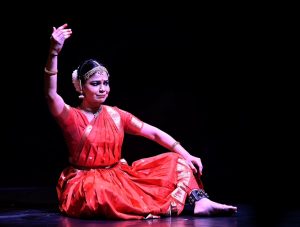
I was blessed with extraordinary collaborators. The four dancers—Soundarya Srivatsa and Navia Natarajan from Bengaluru, Arundhati Patwardhan from Pune, Sayani Chakraborty from Delhi, Sakshi Sawant and Vipin Kushwaha from Mumbai, they are all students of eminent gurus and brought immense depth and discipline.
Our musicians were equally exceptional: Vidya Harikrishna (vocal), Kalishwaran Pillai (nattuvangam), Dakshinamurthy Pillai (mridangam), and Bharatraj (flute). Their sensitivity to the theme elevated every moment.
What do you hope audiences take away from Shringara Bhakti 2.0?
I hope they leave with questions rather than conclusions. Does love culminate in devotion? Or is devotion the highest flowering of love? Can we truly separate desire from surrender?
If the production encourages dancers to approach śṛṅgāra with inwardness rather than excess, and to recognise bhakti as its soul, then the work has fulfilled its purpose. Ultimately, Shringara Bhakti 2.0 is an offering—a reminder that when love is purified, it becomes divine.
