

Datia Palace: A Hidden Architectural Gem on NH 44 Near Jhansi
- CULTURE & HERITAGE TRAVEL & LEISURE
 Life&More
- March 18, 2026
- 0
- 12 minutes read

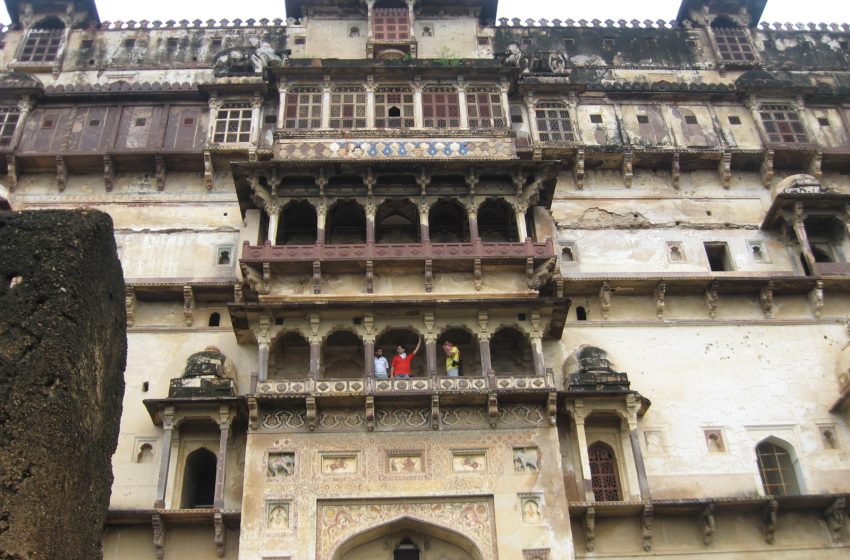
Datia Palace, on NH 44, is one of the best examples of amalgamation of Indo-Islamic architecture. Interestingly, no one ever lived in this palace
Sukriti Tankha
It is not every day that you chance upon a monument like the magnificent Datia Palace. We stumbled upon it during a road journey to Jabalpur along National Highway 44. About 75 km past Gwalior and en route to Jhansi, this grand structure suddenly appeared on the horizon—impossible to ignore, even with time running out before sunset.
Curiosity got the better of us, and we stopped. A local informed us that we were looking at Datia Palace, located in the ancient town of Datia—a place believed to be mentioned in the Mahabharata as Daityavakra.
First Impressions of Datia Palace
A narrow kuccha road led us through a bustling local haat to the towering seven-storey structure. Also known as Bir Singh Dev Palace or Satkhanda Palace, the monument is protected by the Archaeological Survey of India (ASI).
While we waited for the caretaker, Banwari Lal, we took in the surroundings. Despite its age, the palace appeared well-maintained and structurally sound—quiet, imposing, and steeped in history.
History Behind Datia Palace
According to the caretaker, Datia Palace is one of the finest examples of Indo-Islamic architecture in North and Central India. It was built by Bundela king Bir Singh Deo to commemorate the visit of Mughal prince Jahangir.
The story behind its construction is equally fascinating. Jahangir, during his princely years, conspired with Bir Singh Deo to eliminate Abul Fazl—one of the Navratnas in the court of Akbar. Fazl was assassinated near Datia, and later, to honour Jahangir’s visit, the palace was commissioned.
It reportedly took 8 years, 10 months, and 26 days to complete, at a cost of around ₹35 lakh—a massive sum at the time.
Architectural Brilliance of Datia Palace
What makes Datia Palace truly remarkable is its construction:
-
Built entirely using stone and bricks, with no iron or wood
-
Designed in a Swastik layout, symbolising ancient Hindu traditions
-
Structured as a square with four octagonal towers at each corner
-
Adorned with intricate jaali work, murals, and frescoes
-
Crowned with chhatris and ribbed domes
Each floor had a specific purpose:
-
Lower floors: Army quarters
-
Third floor: Guards
-
Fourth floor: Queens and guests
-
Fifth floor: Diwan-e-Khas (royal court)
Interestingly, despite its grandeur, the palace was never occupied by the royal family.
Visitor Experience & Travel Tips
Though a protected monument, Datia Palace remains relatively unexplored, which adds to its charm—but also calls for caution.
Things to keep in mind:
-
Carry a torch if visiting in the evening, as lighting is limited
-
Visitors are allowed up to the fourth floor
-
The entrance area has bats, so covering your head is advisable
-
Wear comfortable footwear for exploring the structure
Why You Should Visit Datia Palace
If you’re travelling through Orchha, Gwalior, or Jhansi, make sure to include Datia Palace in your itinerary.
It’s a rare blend of history, architecture, and storytelling—untouched by heavy tourism and perfect for those seeking offbeat heritage destinations.
Conclusion
Datia Palace is more than just a monument—it’s a silent witness to a fascinating chapter of Mughal and Bundela history. With its stunning Indo-Islamic design and intriguing past, it stands as one of India’s most underrated architectural treasures.
Sometimes, the best travel experiences are the ones you don’t plan—and Datia Palace is exactly that kind of discovery.
Sukriti Tankha is a Dental Surgeon at Clove Dental
