

C Douglas’ “In Search of Fragments”: Exploring Identity, Memory and Materiality in Contemporary Indian Art
- ARTS & CRAFT
 Life&More
- 0
- 6 minutes read

Team L&M
hennai-based artist C Douglas creates works that are inseparable from his life itself. His art is a continuous process of negotiation — between identities, geographies, and artistic ideologies. Whether as an artist from another state living in Chennai, as a resident of the Cholamandal Artists’ Village, or as a contributor to the Madras Art Movement, Douglas occupies multiple spaces simultaneously.
Yet, his work resists easy categorisation. While deeply associated with the Madras Art Movement, his creations do not strictly adhere to its nativist ideology. This constant tension between belonging and detachment informs his artistic voice, positioning him as both an insider and outsider — though he admits to feeling more like the latter.


In Search of Fragments: A Solo Exhibition in New Delhi
A solo exhibition titled In Search of Fragments by C Douglas is currently on display at Akar Prakar. Featuring mixed media paintings on canvas and paper, the show offers a comprehensive look at the artist’s journey from the 1990s to recent years.
Born in Kerala in 1951, Douglas is regarded as one of the most collected artists associated with the Madras Art Movement. This exhibition captures the evolution of his artistic language, particularly his exploration of texture, material, and meaning.
The Grey Works: Exploring Liminality and Silence
Douglas’ works from the 1990s mark a defining phase in his career — the emergence of his signature grey-toned paintings, influenced by German Expressionism. For the artist, grey represents a liminal state, embracing vulnerability over heroism and uncertainty over finality.
These paintings, often crumpled and layered with sand and pigment, possess a distinctive tactile quality. Images of lighthouses, fetal forms, and nebulous figures slowly reveal themselves depending on how light interacts with the surface.
The result is a visual experience marked by slowness and subtlety — where presence and absence coexist, much like an echo.


The Blind Poet Series: Transformation and Recurrence
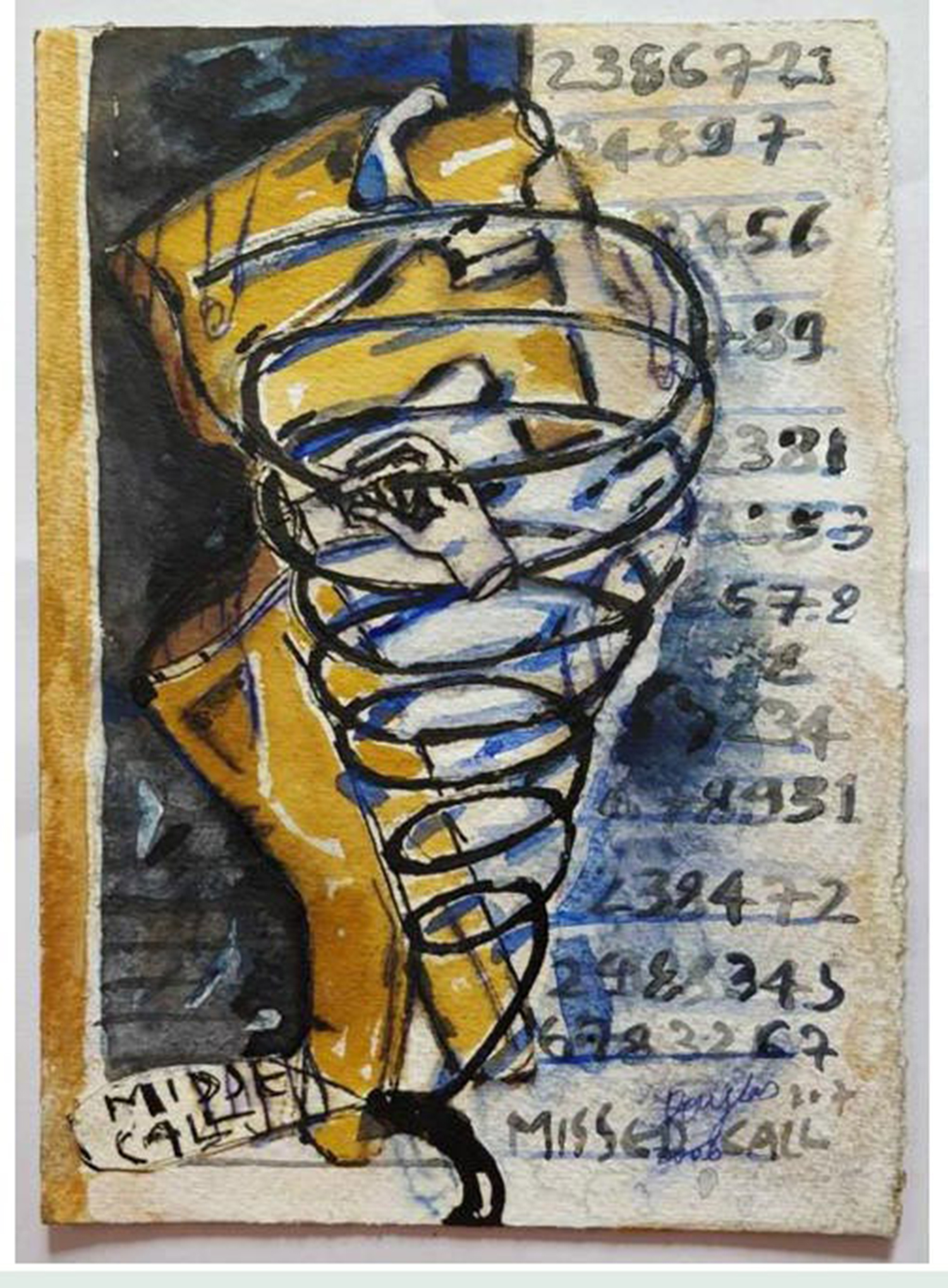
Following his Missed Call series, Douglas transitioned into The Blind Poet and Butterfly series (2012), signalling a significant stylistic shift.
Unlike the sparse, flat compositions of his earlier works, this series returns to a more densely layered and richly coloured style. This non-linear evolution reflects Douglas’ ongoing engagement with themes of recurrence and transformation.
In these works, the subject becomes inseparable from the style — the poet becomes poetic. Motifs such as butterflies, cocoons, and caterpillars recur throughout, symbolising metamorphosis and change.
Interestingly, while these butterflies originate from the poet within the artwork, they transcend his tactile, sand-textured world — glowing instead in vibrant hues of ultramarine and red ochre, suggesting a life beyond their origin.


Materiality and the Body in Art
Douglas’ practice is deeply rooted in the physicality of materials. Reflecting on artistic traditions in South India, he notes the emphasis on the body in artistic expression.
His own works from the 1990s embody this idea through technique and process. He stains paper with tea, crumples it for texture, stitches it, and applies sand — transforming the medium into a living surface.
Using water-based pigments, he allows colour to seep into the material, creating an organic fusion between pigment and paper. This process evokes a regenerative metaphor — akin to earth absorbing rain — where art becomes both creation and transformation.
