

Rakesh Khatri: The Man Working to Bring Back the House Sparrow
- CLIMATE & NATURE INTERVIEWS
 Life&More
- 0
- 14 minutes read

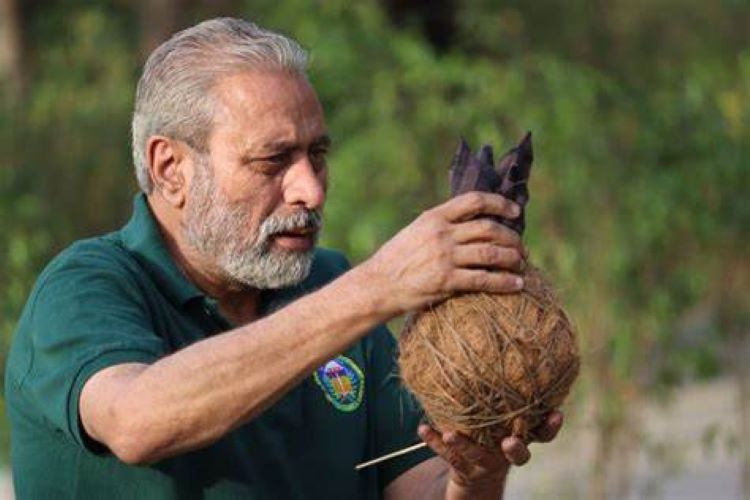
Rakesh Khatri has been working towards bringing birds back into homes
Rajkumari Sharma Tankha
Rising skylines, shrinking open spaces and disappearing green cover trouble Rakesh Khatri deeply. But what pains him even more is the vanishing house sparrow—the tiny bird he grew up watching in his childhood.
Khatri believes that the rapid decline of sparrows and other birds is largely due to urbanisation and humans occupying natural habitats. Determined to reverse this trend, he has dedicated his life to environmental awareness—organising theatre workshops, nature trails, documentary films and birdhouse-making sessions to help bring the sparrows back.
The Birth of Eco Roots Foundation
A resident of Mayur Vihar, Khatri founded the Eco Roots Foundation in 2012 with the aim of promoting ecological balance.
He strongly believes in the famous environmental principle:
“We do not inherit the Earth from our ancestors; we borrow it from our children.”
A passionate naturalist, filmmaker and theatre activist, Khatri has combined creativity with activism to spread environmental awareness across the country.
The Save the House Sparrow Campaign
Khatri is best known for his Save the House Sparrow programme, which focuses on educating people about bird conservation.
Through workshops conducted in schools, resident welfare associations and corporate offices, he teaches participants how to build eco-friendly birdhouses that encourage sparrows to nest in urban areas again.
So far:
-
Workshops have been held in more than 1,400 schools
-
Over 18,000 children have learned to build birdhouses
-
Thousands of birdhouses have been installed across cities
These small initiatives are helping bring the beloved “goraiya” back into urban neighbourhoods.
International Recognition for Sparrow Conservation
Khatri’s innovative birdhouse design earned him the International Green Apple Award for Sparrow Conservation at the House of Commons in 2013.
One of his successful initiatives involved placing 100 birdhouses along the DND Flyway.
“Most of these birdhouses were adopted by sparrows,” Khatri says with pride.
From Filmmaking to Environmental Activism
Before entering the environmental sector, Khatri had a successful career in media. He started as a freelance photographer in Mumbai and later moved into documentary filmmaking and television production.
Over the years, he has created:
-
More than 270 documentary films
-
Several television serials
-
A series on traditional architecture titled A Home From the Past
However, his journey into environmental activism began after a deeply disturbing experience.
The Incident That Changed His Life
Nearly two decades ago, during a visit to Sariska Tiger Reserve, Khatri came across the carcass of a sambar deer calf.
Curious to know what had caused its death, he arranged for a post-mortem examination. The results revealed that polythene bags had accumulated in the animal’s intestines, eventually leading to its death.
That moment became a turning point in his life.
Though he continued working in media for some time, the incident kept troubling him. Finally, in 2003, he decided to leave his job and dedicate himself to environmental causes.
Building Awareness Through Education
After moving to Delhi, Khatri initially worked with several environmental organisations before establishing his own foundation in 2012.
One of his first major projects came from Panasonic, which involved conducting theatre workshops on climate change for school students.
The programme was massive in scale:
-
240 schools
-
24 cities
-
17 states
-
12 languages
The project’s impact was so significant that Khatri’s name was recorded in the Limca Book of Records in 2013.
Reviving Sparrow Habitats
Soon after, Khatri began focusing intensively on house sparrow conservation.
“All through my childhood, sparrows were constant companions. But suddenly they disappeared. I felt I had to do something,” he says.
His first birdhouse design used coconut shells, neem sticks and khas fibre, but it did not work well. After several experiments, he created improved birdhouses using chik (bamboo blinds) and jute, which sparrows readily adopted.
Today, these birdhouses can be seen in areas such as Kondli, Geeta Colony and Ashok Nagar in Delhi, where sparrows have gradually begun returning.
Training Teachers and Students
Beyond students, Khatri has also trained 7,000 teachers across 30 states, indirectly reaching over 1.5 lakh children with environmental education programmes.
His approach focuses on making learning interactive and engaging through activities such as:
-
Birdhouse workshops
-
Nature trails
-
Environmental games and riddles
-
Theatre performances
Working on Water Conservation
Currently, Khatri is working on another initiative called Neer aur Naari, a project supported by the Department of Science and Technology India.
The programme focuses on the role of women in water conservation and involves girls from classes 6 to 9 in 200 schools across 20 states.
Students create street plays and stage performances highlighting the contributions of women who have helped conserve water in their communities.
Environmental Awareness Through Play
Khatri also uses traditional games such as Chidiya Ud, Chian and Stapu to communicate environmental messages to children.
His aim is simple—to make environmental awareness fun, interactive and memorable.
A Call for Individual Responsibility
Khatri believes that environmental protection cannot succeed unless individuals take responsibility.
“It is high time we start saving our environment. Conservation must begin at the individual level,” he says.
He also points out that environmental action is often reduced to planting trees without caring for them afterwards.
For real change to happen, he believes people must develop a deeper emotional connection with nature.
