

Museum Country
- ASHISH KHOKAR CULTURE & HERITAGE TRAVEL & LEISURE
 Life&More
- 3
- 18 minutes read

Which is why discovering three swanky new museums in three weeks of travel in South India (that’s not one city as many North Indians think! but India’s most cultured part and its denizens, paying maximum taxes and having the highest GDP and GST contribution too) proved to be an adventure in the month that was.
First stop – in an ultra-modern SUV driven by Ravi from Bangalore to Mysore – is the Heggade Vintage Car Museum. OMG. A private Museum 12 km before one enters the royal and highly rated city of Mysore, this ode to founder Heggade is a unique collection of shining cars, collected from all over and some recent ones, donated. The marquee items are all there: the Rolls, the Cads, even the Ambys! I was taken back to my childhood upon seeing a Landmaster, the pre-runner to the iconic Ambassador car that ruled the roads for five decades, until Maruti replaced it. Most cars had either been restored well or in mint condition. Spic, slick and span – door handles, tyres and bonets. All in good condition. Hats off to this display. A must stop on the way to Mysore.
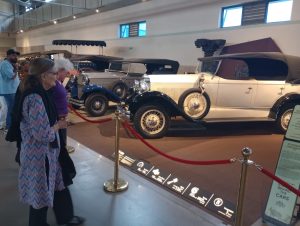
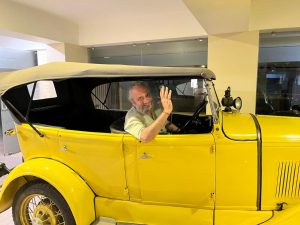
The building itself looks like a huge tyre. Smart idea, and can get seen from far in the highway. Under it is a fully-developed, high-tech display system, signage, clarity of provenance and progression. And a first- class recreational facility with clean toilets and canteen. Food is good, service with a smile is a cool place for alla. One wishes one could touch and feel at least one car but then we Indians being too democratic, are likely to let the car be full of smudges and spots. I have always missed possessing one but was happy to see Hillman from my grandfather’s days in Chandigarh and a yellow beauty a sardar has in Ahmedabad. Here it is
Mysore has lots to offer but some of its best hidden markets are not of gold or silver but farm fresh greens! The red soil of the region is home to cashew and coffee estates, Karnataka’s biggest produce.
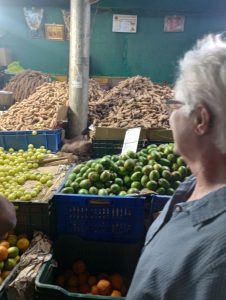
Next stop The Veg Market off Devraj Urs Road. Fresh vegetables like from the source. For the price of a song. Unpolished, raw display and reeking of soil of the land. A feast!
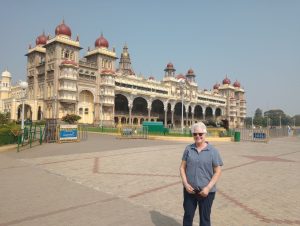
The Palace in Mysore. Rich as they come, gold pillars, painting and pelf. The entrance looks like a very bad cowshed of a ticket office, with small windows, rough staff and systems. Why can’t one show some respect for the visitor, instead of treating them like a herd? Inside again is like a herd being led by a nerd. Waste of a morning, really. The Mysore Palace is an overrated relic. One didn’t learn much, the objects were far from enclosure, without proper labelling or history.
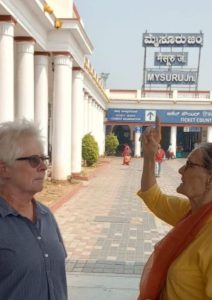
Herd mentality could not be seen in the very fine Rail Museum, behind the colonial-looking actual Mysore Junction. A well-kept place, with a neat display and old coaches and engines one could actually touch and enter. The toy train was a delight for the old and new. And the actual Mysore Junction station: Have you ever seen a railway station without people in India! Wow. Dr Ada Hall, a distinguished eye surgeon from the USA, wondered where the famed one plus billion people were? Her eyes could not find any!
Continuing her journey she ended up in The Serai, Kabini, in search of a tiger. Tiger Tipu Sultan she could see in Srirangapatna and Mysore but a real tiger proved to be elusive. Safaris have been closed since months due to the animal being hungry enough to come to villages abutting the Bandipur-Nagerholle National Park, to find food. But the beauty is that birds and bees; ferns and fauna could be found in plenty in The Serai, run efficiently by the staff.
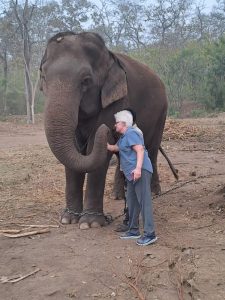
Dr Ada McIntire Hall could even get a birthday bed! The staff had made jungle mei mangal! Next day, Laxmi the elephant blessed her and she was delighted to see langurs (not me!) first thing in the morning, in addition to spotted deers, peacocks, even a mongoose! Wild boars and geese; egrets and otters she had seen in plenty a night before at her birthday party!
If Mysore was royal then the royal mess that awaited in Bengaluru, the high-tech village of ours, made return to urbanisation an urban nightmare. One preferred the wild life in jungles to this urban jungle with real wild life! Bengaluru is bursting at its seams. Its imminent collapse is for all to see, EXCEPT the rulers! The netas couldn’t care less or seems they care too much about their own survival and care two hoots for the public. Part of the problem is the people themselves: No one speaks up and the rot continues.
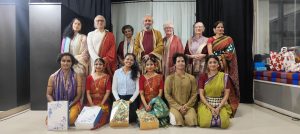
In all this rot, a few do-gooders like Mysore Nagaraj, belonging to both the cities, create areas of artistic excellence even in a heavily-congested market place like Hanumanthanagar. His Articulate studio, under supervision of a bright young brigade, headed by an ebullient and efficient Jena Laxminarayan, pulled out all stops to host Dr Ada McIntire Hall Barnes (her name kept getting longer as the weeks progressed! making her realise how generous and democratic we Indians can be) at a special command performance by ace Odissi talent Madhulita Mohapatra with student Sahana Maiyya Kuchipudi by dynamic Gururaj, Bharatanatyam by twins Archana Chetna, modern LYRICAL ( whatever that means! But, basically high school level film song dance of sorts) and Kathak by Jena himself, who is both an SNA yuva gem and now a freshly-minted Tagore Fellow.
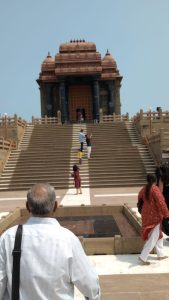
Fellows and countrymen, he did not say. Brothers and sisters, he said, in Chicago in 1893 when he addressed the world assembly of religions. Swami Vivekananda (12 January 1863 – 4 July 1902), born Narendranath Datta, was an Indian Hindu monk, philosopher, author, religious teacher, and the chief disciple of the Indian mystic Ramakrishna. Vivekananda was a major figure in the introduction of Vedanta and Yoga to the Western world, and is credited with raising interfaith awareness and elevating Hinduism to the status of a major world religion. Swami Vivekanand, my childhood hero (no, not Batman or Superman, we were exposed to Indian culture and traditions right from childhood in sanskar nagari Baroda – Modi land actually, the three-term PM’s previous constituency as CM of Gujarat and then as first-term MP cum PM!) was gifted to us via little pocket books bought every Sunday evening arti at Ramakrishna Mission in Delhi. Off Paharganj or Panchkuian road. Those little books contained gems that gave us insights into the spiritual wealth of India. We grew up reading every magazine that was published in India and some from abroad. I failed miserably in all my science subjects but topped in history, literature and geography. Today, it helps me reconstruct and write. And today genZ on Facebook? What does it really teach us? Envy, greed and jealousy at worst and how to become a product, at best.
I was at Swami Vivekananda in Kanyakumari, not minding the horrifying lines of hundreds waiting in the scorching sun at lunchtime to catch a ferry to the famed rock edifice. First the ticket lines are serpentine. It’s like prison cages. Suffocating. No clarity in signage. Then the wait for a ferry is like a line for food in jail as we used to see in old Hindi films. The entire experience is traumatic and can be made nice if only the babus and netas (bureaucrats and politicians) responsible for the area are made ONCE to stand in such a line – the way all ordinary citizens stand – for an hour or so. On a hot, happening day with thousands of others who have come all the way from all over India. Let the babus and netas suffer the same indignity and hardships. They will come to their senses and offer better public service. It’s a place of great spiritual significance not a rock concert or circus. The Rock is burning hot when one alights OFF the ferry. Eight months in a year it is a hot summer in the southernmost part of India. No rocket science, this. Common sense. Once on the Rock, The administration charges again for admission to the hallowed portals. Why could it not be charged once with the ferry ticket? Then again, on hot rock, shoes have to be taken off, no protective socks given and shoes have to be deposited somewhere far, where rude staff scowls some more. Their attitude is: Why have you come? Then one walks on charcoal-like hot rock surface to either the footprints of Devi Kanyakumari or the hall of Vivekananda. There is a little white strip of thermo coolant paint but one fat human can block it by taking a selfie. If this was Japan or Germany, they would make it such a memorable experience. No, not India. In India, pilgrimage spots are akin to an endurance test. Torture is the moot idea and acceptance its by product. That’s why I’m even writing all this in a CULTURE column here. This is our culture too. Indifference. Apathy. Disregard. What do the handicapped people do? Are they excluded totally from the divine tourism torture or they have a secret lift and ride to the hallowed areas? The management of the ferry and rock edifice under TN govt? Who is in-charge? All of India comes there, so it is a national shame too. If PM Modi (as fan and follower of Swami Vivekananda) was to visit this as a common man, next day he’d order a bridge over troubled waters. If his admin can build tunnels in Kashmir mountains, longest bridges in jungles of Assam then why not just a five-km-long connecting bridge or an underground aqua tunnel linking mainland with Swami Vivekananda Rock Memorial? That way, under-sea aqua life can be seen too and what a really COOL experience in scorching sun would it be. Children would love our own Singapore-type Sentosa under-water park right here in India. Think outta box Tourism Dept of TN.
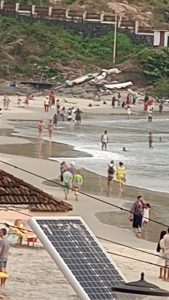
Kerala has. Even ordinary Uber drivers like Arun know landmarks, can guide properly and drive at a fixed speed. The Padmanabhpuram Palace on the way to KK (that’s Kanyakumari, where the Highway is no or low way! Half-broken, half-built, rest is like a bad art under progress! since Covid days, that’s five years ago) is yet another gem, nicely managed even if the toilets are horrible. Broken, wet and run by a Bihari from Patna (Sulabh International). The little museum in the Palace complex is beautifully displayed. Staff is polite but barely. Do they want tourists? Or only their euros and dollars? The blast from a nearby temple made even conversing impossible. We know how to drive tourists deaf.
That’s Kerala for you. It is a good example of boon, boom and bane of tourism. Hotel yes, hangers no! Toilet yes, paper no! Fruit yes, plate no! Driver yes, manners no! Car yes, petrol no (only petro dollars!). The list can go on: Homestay types, with four or five rooms, a tadpole of a swimming pool and one car park space pompously call themselves ayur/vedic boutique villa! These are cute spaces but often with untrained staff. Housekeeping to them means keeping the house! No towels or tea in the room. Under-dimensioned for even one car to come turn in. No real road to U-turn. Rooms are well-made but there are no hooks in the bathroom to even hang clothes. Tea kettle yes but working plug/ point no! Fan yes but regulator no. Toilet yes, paper no! Dressing table there, lights no. The cook looked lost when some items on the menu were read. Best was: Sitting in Les Marine Restaurant on Kovalam beach, when I asked for the most easy and common drink – COCONUT WATER – the rude waiter, acting no less than the owner, said: NO. Go to the beach and get. (Sub text: GO CLIMB A TREE AND GET YOURSELF!). Kerala may be God’s own country but it is also a devil’s workshop!
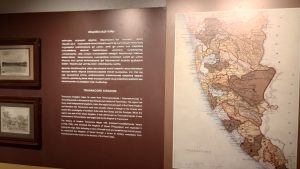
Government places and museums are sadder. One of the architectural landmarks from the 1880s is the Napier Building where Raja Ravi Varma Museum, a zoo, an aquarium and best artefacts abound. Add, Wall murals a la Mattancherry Palace. I know some of these things from my previous incarnation as a director of INTACH 35 years ago. Yes, I’m myself ancient now and a museum piece! My birthday being 29.
Feb (or, in non-leap years, first March) I look younger than my nearly 70 years. So, when I look at historical buildings and museums I relate well as a student of history too.
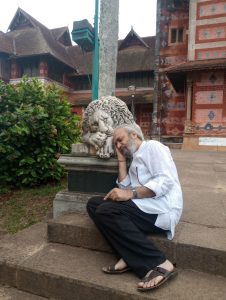
Napier Building is a beautiful building, but poorly kept. It has some of the best artefacts and historical treasures. Buddha meets Bali. Chola meets Pali. The sleeping lion at the entrance says it all.
The MP of Trivandrum or Thiruvananthapuram – Dr one and only Shashi Tharoor – a student of history no less, from one of the colleges I tried to study in Delhi (the St. Stephen’s in Delhi), is a culturally sensitive person. It’d be interesting to learn from him his views – in SIMBLE EEENGLISH PLEASE!
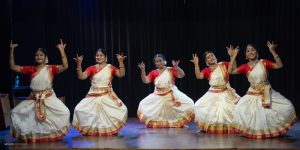
The sad state of government museums is a tragedy in India with so much cultural wealth. Such wealth was seen in Regatta Madhavi Chandran and other students of ace guru Girija Chandran disciples. 800 students/ 28 teachers. They all gave a good account of their art of soothing Mohiniattam. In North or Chennai or Mumbai one sees Mohiniattam on steroids! Speed has affected its grace. Not here in Malati or Madhavi Chandran or all who danced with her like Mini T.Manoj, Karthika Gopan, Anjali Mohandas and Sneha B.
Vidhun Kumar the fine male BN dancer gave a splendid account of his art and the icon of Modern Indian dance, based in Trivandrum, Daksha Sheth chief guest. She is so deep and dignified that she is today a real great in the field of contemporary dance. A giant and a genius. All got together to wish me on the invisible leap year birthday!
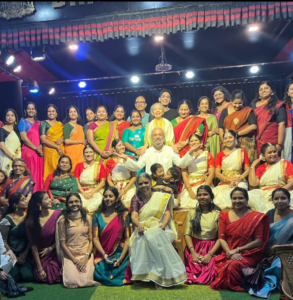
It is indeed heartening to see performing arts flourish but museum arts are sad. Now that a few private museums are coming up with show spunk and substance one feels there’s hope and scope. India is so layered that no generalizations can be made. We are a museum piece full of new museums. There’s no place like India but then as someone wise (Sultan Singh, sculptor-poet-activist from namma Bangalore) said: India is not for the faint hearted!
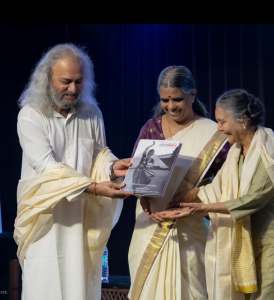
PS: By the time the Epic Fury/ War over and normal flights restored, Dr. Ada McIntire Hall Barnes will become Trooper! She survived it all and smiled and sailed through – like a true trooper – as they say in her native place, America.
Saraswati has blessed Ashish Khokar totally for he has written 51 books, 5k articles in print media in the last 45 years (for the Times of India, The Hindu, First City, Life Positive, the India Magazine and India Today). He created 85 modules for the UGC e-pathshala MA Course. A pioneer in arts administration, he served the Delhi State Akademi, INTACH in the 1980s and worked internationally in France, Sweden, Germany and China in the 1990s. He was a visiting expert/professor to many universities abroad (Italy, Germany, USA, Malaysia and Mauritius). He taught special modules at MSU-Baroda, Punjab University Chandigarh, Bangalore and Mangalore universities. He has been bringing out India’s only yearbook on dance for the last 25 years – called attendance which is endorsed by UNESCO-CID as a model dance journal. He gives attendance awards to youngsters and seniors. Till date 40+ attenDance awards have been given. A list of 51 books and 40+ awardees can be seen on www.attendance-india.com. He is also the longest serving columnist for narthaki.com and India Today – contributing articles for 25 years now. Currently, he is the Chairman of NEEMRANA Dance Initiative and Curator of the Mohan Khokar Dance Collection & Archives@ IGNCA, Delhi. The India HABITAT centre and the IIC avail his expertise for special events and the world over, and he is treated as an authority on Indian dance. More details on www.attendance-india.com

3 Comments
A delightful read on your adventurous travels across the South! I have fond memories of visiting all of the places you’ve mentioned. Loved how you highlighted the attractions at all these places, and the dire need for making it a pleasant experience for tourists.
The inspiring Vivekananda Rock memorial, the exquisite Padmanabhapuram Palace, the luxury (jangal) experience at the Serai Kabini and our very own state crown jewel Mysore Palace… Wow! What an itinerary!
Culture, Coach and Canteen- these form the backbone of our Country. A Course on Civic sense must be made Compulsory for all(as you’ve rightly emphasized)!
What a wonderful and insightful article, Ashish ji. Your writing reminds us how important it is to document, preserve, and experience our cultural heritage through such places. I feel truly humbled to find my name mentioned in this journey. Thank you for the opportunity and for your constant encouragement. I deeply appreciate your tireless efforts in promoting Indian arts and culture.
It was a truly wonderful, informative, and awareness-creating article highlighting the rich cultural tourism of Karnataka, Kerala, and Tamil Nadu.
I personally had a very delightful experience visiting iconic destinations such as the Mysore Palace, the Vivekananda Rock Memorial, the Kanyakumari Temple, and exploring the serene beauty of Kerala Tourism. Each place reflects India’s incredible heritage, spirituality, and diversity.
However, there are still challenges related to adequate tourism infrastructure and hospitality. In many areas, we continue to rely on conventional systems, but development takes time, and gradual improvements are visible.
On a positive note, initiatives like the upcoming Yuge Yugeen Bharat National Museum are highly promising. The historic North Block and South Block in Delhi are set to house this grand project, which is expected to become one of the world’s largest museums.
I sincerely hope such initiatives continue to grow, and that we see more world-class cultural and tourism developments across India in the future.